Results 111 to 120 of 121 | « previous | next »
- The Bourne ultimatum [videorecording (DVD)] / by Allen, Joan,1956; Burns, Scott Z; Considine, Padd; Crowley, Patric; Damon, Mat; Finney, Albert,1936; Gilroy, Tony; Glenn, Scott,1942; Greengrass, Pau; Ludlum, Robert,1927-200; Marshall, Fran; Nolfi, Georg; Ramirez, Edgar; Sandberg, Paul; Stiles, Julia,1981; Strathairn, Davi; Bourne Again (Firm; Kennedy/Marshall Company; Ludlum Entertainment (Firm; Universal Pictures (Firm; Universal Studios Home Entertainment (Firm; Universal Studios Home Video (Firm;
 Director of photography, Oliver Wood ; editor, Christopher Rouse ; music, John Powell ; costume designer, Shay Cunliffe ; production designer, Peter Wenham ; special effects, Mark Noel ; visual effects supervisors, Peter Chiang, Charlie Noble.Matt Damon, Julia Stiles, David Strathairn, Scott Glenn, Paddy Considine, Edgar Ramirez, Albert Finney, Joan Allen.Bourne is once again brought out of hiding. This time, inadvertently by London-based reporter Simon Ross. Simon is trying to unveil Operation BlackBriar which is an upgrade to Project Treadstone, by writing about it in a series of newspaper columns. Bourne sets up a meeting with Ross and realizes instantly they're being scanned. Information from the reporter stirs a new set of memories, and Bourne must finally, ultimately, uncover his dark past whilst dodging The Company's best efforts in trying to eradicate himCanadian Home Video Rating: 14ADVD ; widescreen presentation ; Dolby Digital 5.1 surround
- Subjects: Ludlum, Robert, 1927-2001; Adventure film; Bourne, Jason (Fictitious character); Feature film; Memory disorders; Reporters and reporting; Secrecy; Thrillers (Motion pictures, television, etc.;
- © c2007., Universal ; Distributed by Universal Studios Canada,
- Available copies: 1 / Total copies: 1
-
unAPI
- Stolen focus : why you can't pay attention - and how to think deeply again / by Hari, Johann,author.;
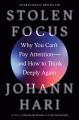 Includes bibliographical references and index."Our ability to pay attention is collapsing. From the New York Times bestselling author of Chasing the Scream and Lost Connections comes a groundbreaking examination of why this is happening-and how to get our attention back. Like so many of us, Johann Hari was finding it much harder to focus than he used to. He found that a life of constantly switching from device to device, from tab to tab, is diminishing and depressing. He tried all sorts of self-help solutions-even abandoning his phone for three months-but in the long-term, nothing seemed to work. So Hari went on an epic journey across the world to interview the leading experts on human attention and to study their scientific findings-and learned that everything we think we know about this crisis is wrong. In the U.S., teenagers now focus on a task for only sixty-five seconds on average, and office workers manage only three minutes. We think this inability to focus is a personal flaw, an individual failure to exert enough willpower over our devices. The truth is even more disturbing: Our focus has been stolen by powerful external forces, and the science shows that these forces have been ramping up for decades-leaving us uniquely vulnerable, when social media arrived, to corporations determined to raid our attention for profit. These forces have been so successful that our collapse in attention is behind many of the wider problems society faces. In Stolen Focus, Hari embarks on a thrilling journey, taking readers from veterinarians who diagnose dogs with ADHD, to Silicon Valley dissidents who exposed social media companies' furtive attempts to hack our focus; from a favela in Rio where everyone lost their attention in a particularly catastrophic way, to an office in New Zealand that discovered a remarkable technique to restore their workers' attention. In this urgent, deeply researched book, Hari shows that if we understand the twelve true causes of this crisis-from the collapse of sustained reading to the disruption of boredom to rising pollution-we, as individuals and as a society, can finally begin to solve it by staging an "attention rebellion." Finally, we have a way to get our focus back"--
- Subjects: Attention.; Distraction (Psychology);
- Available copies: 1 / Total copies: 1
-
unAPI
- Clyde Fans [electronic resource] : by Seth.aut; cloudLibrary;
 Legendary Canadian cartoonist Seth’s magnus opus Clyde Fans, two decades in the making, appeared on twenty best of 2019 lists, including those from the New York Times, the Guardian, and Washington Post, and was nominated for an Eisner Award and the Giller Prize. Clyde Fans peels back the optimism of mid-twentieth century capitalism, showing the rituals, hopes, and delusions of a vanished middle-class—garrulous self-made men in wool suits extolling the virtues of their wares to taciturn shopkeepers. Much like the myth of an ever-growing economy, the Clyde Fans family business is a fraud. The patriarch has abandoned it to mismatched sons, one who strives to keep the company afloat and the other who retreats into his memories. Abe and Simon Matchcard are brothers, struggling to save their archaic family business selling oscillating fans in a world switching to air conditioning. Simon flirts with becoming a salesman as a last-ditch effort to leave the protective walls of the family home, but is ultimately unable to escape Abe’s critical voice in his head. As Clyde Fans Co. crumbles, so does the relationship between the two men, who choose very different life paths but both end up utterly unhappy. Seth’s intimate storytelling and gorgeous art allow cityscapes and detailed period objects to tell their own stories as the brothers struggle to find themselves suffocating in an airless home. Twenty years in the making, Clyde Fans peels back the optimism of mid-twentieth century capitalism. Legendary Canadian cartoonist Seth lovingly shows the rituals, hopes, and delusions of a middle-class that has long ceased to exist in North America—garrulous men in wool suits extolling the virtues of the wares to taciturn shopkeepers with an eye on the door. Much like the myth of an ever-growing economy, the Clyde Fans family unit is a fraud—the patriarch has abandoned the business to mismatched sons, one who strives to keep the business afloat and the other who retreats into the arms of the remaining parent. Abe and Simon Matchcard are brothers, the second generation struggling to save their archaic family business of selling oscillating fans in a world switching to air conditioning. At Clyde Fans’ center is Simon, who flirts with becoming a salesman as a last-ditch effort to leave the protective walls of the family home, but is ultimately unable to escape Abe’s critical voice in his head. As the business crumbles so does any remaining relationship between the two men, both of whom choose very different life paths but still end up utterly unhappy. Seth’s intimate storytelling and gorgeous art allow urban landscapes and detailed period objects to tell their own stories as the brothers struggle to find themselves suffocating in an airless city home. An epic time capsule of a storyline that begs rereading.The first graphic novel ever nominated for the Scotiabank Giller Prize! Legendary Canadian cartoonist Seth’s magnus opus Clyde Fans, two decades in the making, appeared on twenty best of 2019 lists, including those from the New York Times, the Guardian, and Washington Post, and was nominated for an Eisner Award and the Giller Prize. Clyde Fans peels back the optimism of mid-twentieth century capitalism, showing the rituals, hopes, and delusions of a vanished middle-class—garrulous self-made men in wool suits extolling the virtues of their wares to taciturn shopkeepers. Much like the myth of an ever-growing economy, the Clyde Fans family business is a fraud. The patriarch has abandoned it to mismatched sons, one who strives to keep the company afloat and the other who retreats into his memories. Abe and Simon Matchcard are brothers, struggling to save their archaic family business selling oscillating fans in a world switching to air conditioning. Simon flirts with becoming a salesman as a last-ditch effort to leave the protective walls of the family home, but is ultimately unable to escape Abe’s critical voice in his head. As Clyde Fans Co. crumbles, so does the relationship between the two men, who choose very different life paths but both end up utterly unhappy. Seth’s intimate storytelling and gorgeous art allow cityscapes and detailed period objects to tell their own stories as the brothers struggle to find themselves suffocating in an airless home. Twenty years in the making, Clyde Fans peels back the optimism of mid-twentieth century capitalism. Legendary Canadian cartoonist Seth lovingly shows the rituals, hopes, and delusions of a middle-class that has long ceased to exist in North America—garrulous men in wool suits extolling the virtues of the wares to taciturn shopkeepers with an eye on the door. Much like the myth of an ever-growing economy, the Clyde Fans family unit is a fraud—the patriarch has abandoned the business to mismatched sons, one who strives to keep the business afloat and the other who retreats into the arms of the remaining parent. Abe and Simon Matchcard are brothers, the second generation struggling to save their archaic family business of selling oscillating fans in a world switching to air conditioning. At Clyde Fans’ center is Simon, who flirts with becoming a salesman as a last-ditch effort to leave the protective walls of the family home, but is ultimately unable to escape Abe’s critical voice in his head. As the business crumbles so does any remaining relationship between the two men, both of whom choose very different life paths but still end up utterly unhappy. Seth’s intimate storytelling and gorgeous art allow urban landscapes and detailed period objects to tell their own stories as the brothers struggle to find themselves suffocating in an airless city home. An epic time capsule of a storyline that begs rereading.General adult.
- Subjects: Electronic books.; Literary;
- © 2021., Drawn & Quarterly,
-
unAPI
- The Anxious Generation How the Great Rewiring of Childhood Is Causing an Epidemic of Mental Illness [electronic resource] : by Haidt, Jonathan.aut; Pratt, Sean.nrt; Haidt, Jonathan.nrt; CloudLibrary;
 From New York Times bestselling coauthor of The Coddling of the American Mind, an essential investigation into the collapse of youth mental health—and a plan for a healthier, freer childhood After more than a decade of stability or improvement, the mental health of adolescents plunged in the early 2010s. Rates of depression, anxiety, self-harm, and suicide rose sharply, more than doubling on most measures. Why? In The Anxious Generation, social psychologist Jonathan Haidt lays out the facts about the epidemic of teen mental illness that hit many countries at the same time. He then investigates the nature of childhood, including why children need play and independent exploration to mature into competent, thriving adults. Haidt shows how the “play-based childhood” began to decline in the 1980s, and how it was finally wiped out by the arrival of the “phone-based childhood” in the early 2010s. He presents more than a dozen mechanisms by which this “great rewiring of childhood” has interfered with children’s social and neurological development, covering everything from sleep deprivation to attention fragmentation, addiction, loneliness, social contagion, social comparison, and perfectionism. He explains why social media damages girls more than boys and why boys have been withdrawing from the real world into the virtual world, with disastrous consequences for themselves, their families, and their societies. Most important, Haidt issues a clear call to action. He diagnoses the “collective action problems” that trap us, and then proposes four simple rules that might set us free. He describes steps that parents, teachers, schools, tech companies, and governments can take to end the epidemic of mental illness and restore a more humane childhood. Haidt has spent his career speaking truth backed by data in the most difficult landscapes—communities polarized by politics and religion, campuses battling culture wars, and now the public health emergency faced by Gen Z. We cannot afford to ignore his findings about protecting our children—and ourselves—from the psychological damage of a phone-based life. *Includes a downloadable PDF of charts, graphs, and images from the book
- Subjects: Audiobooks.; Mental Health; Teenagers; Stress Management;
- © 2024., Penguin Random House,
-
unAPI
- The underworld : journeys to the depths of the ocean / by Casey, Susan,1962-author.;
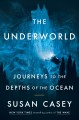 Includes bibliographical references."From New York Times bestselling author Susan Casey, an awe-inspiring portrait of the mysterious world beneath the waves, and the men and women who seek to uncover its secrets For all of human history, the deep ocean has been a source of wonder and terror, an unknown realm that evoked a singular, compelling question: What's down there? Unable to answer this for centuries, people believed the deep was a sinister realm of fiendish creatures and deadly peril. But now, cutting-edge technologies allow scientists and explorers to dive miles beneath the surface, and we are beginning to understand this strange and exotic underworld: A place of soaring mountains, smoldering volcanoes, and valleys 7,000 feet deeper than Everest is high, where tectonic plates collide and separate, and extraordinary life forms operate under different rules. Far from a dark void, the deep is a vibrant realm that's home to pink gelatinous predators and shimmering creatures a hundred feet long and ancient animals with glass skeletons and sharks that live for half a millennium--among countless other marvels. Susan Casey is our premiere chronicler of the aquatic world. For The Underworld she traversed the globe, joining scientists and explorers on dives to the deepest places on the planet, interviewing the marine geologists, marine biologists, and oceanographers who are searching for knowledge in this vast unseen realm. She takes us on a fascinating journey through the history of deep-sea exploration, from the myths and legends of the ancient world to storied shipwrecks we can now reach on the bottom, to the first intrepid bathysphere pilots, to the scientists who are just beginning to understand the mind-blowing complexity and ecological importance of the quadrillions of creatures who live in realms long thought to be devoid of life. Throughout this journey, she learned how vital the deep is to the future of the planet, and how urgent it is that we understand it in a time of increasing threats from climate change, industrial fishing, pollution, and the mining companies that are also exploring its depths. The Underworld is Susan Casey's most beautiful and thrilling book yet, a gorgeous evocation of the natural world and a powerful call to arms"--
- Subjects: Deep-sea sounding.; Marine ecology.; Marine ecosystem health.; Ocean bottom.; Ocean; Ocean.; Oceanography; Submarine topography.;
- Available copies: 1 / Total copies: 1
-
unAPI
- King of the armadillos / by Chin-Tanner, Wendy,author.;
 "A transcendent debut novel about family, love, and belonging, set against the backdrops of 1950s New York City and a historical leprosarium in Louisiana, following one young man's quest to not only survive, but live a full and vibrant life. Perfect for fans of Jacqueline Woodson's Red at The Bone, Netflix's Atypical, and The Guernsey Literary and Potato Peel Pie Society. Victor Chin's life is turned upside down at the tender age of 15. Diagnosed with Hansen's disease, otherwise known as leprosy, he's forced to leave the familiar confines of his father's laundry business in the Bronx - the only home he's known since emigrating from China with his older brother - to quarantine alongside patients from all over the country at a federal institution in Carville. At first, Victor is scared not only of the disease, but of the confinement, and wants nothing more than to flee. Between treatments he dreams of escape and imagines his life as a fugitive. But soon he finds a new sense of freedom far from home - one without the pull of obligations to his family, or the laundry business, or his mother back in China. Here, in the company of an unforgettable cast of characters, Victor finds refuge in music and experiences first love, jealousy, betrayal, and even tragedy. But with the promise of a life-changing cure on the horizon, Victor's time at Carville is running out, and he has some difficult choices to make. A groundbreaking work of historical fiction, King of the Armadillos announces Wendy Chin-Tanner as an extraordinary new voice. Inspired by her father's experience as a young patient at Carville, this tender coming-of-age novel is a captivating look at a forgotten radical community and a lyrical exploration of the power of art"--
- Subjects: Bildungsromans.; Historical fiction.; Novels.; Chinese Americans; Families; Leprosy;
- Available copies: 1 / Total copies: 1
-
unAPI
- The anxious generation : how the great rewiring of childhood is causing an epidemic of mental illness / by Haidt, Jonathan,author.;
 Includes bibliographical references and index."From New York Times bestselling coauthor of The Coddling of the American Mind, an essential investigation into the collapse of youth mental health-and a plan for a healthier, freer childhood. After more than a decade of stability or improvement, the mental health of adolescents plunged in the early 2010s. Rates of depression, anxiety, self-harm, and suicide rose sharply, more than doubling on most measures. Why? In The Anxious Generation, social psychologist Jonathan Haidt lays out the facts about the epidemic of teen mental illness that hit many countries at the same time. He then investigates the nature of childhood, including why children need play and independent exploration to mature into competent, thriving adults. Haidt shows how the "play-based childhood" began to decline in the 1980s, and how it was finally wiped out by the arrival of the "phone-based childhood" in the early 2010s. He presents more than a dozen mechanisms by which this "great rewiring of childhood" has interfered with children's social and neurological development, covering everything from sleep deprivation to attention fragmentation, addiction, loneliness, social contagion, social comparison, and perfectionism. He explains why social media damages girls more than boys and why boys have been withdrawing from the real world into the virtual world, with disastrous consequences for themselves, their families, and their societies. Most important, Haidt issues a clear call to action. He diagnoses the "collective action problems" that trap us, and then proposes four simple rules that might set us free. He describes steps that parents, teachers, schools, tech companies, and governments can take to end the epidemic of mental illness and restore a more humane childhood. Haidt has spent his career speaking truth backed by data in the most difficult landscapes-communities polarized by politics and religion, campuses battling culture wars, and now the public health emergency faced by Gen Z. We cannot afford to ignore his findings about protecting our children-and ourselves-from the psychological damage of a phone-based life"--
- Subjects: Child development; Child mental health; Children; Internet and children; Social media;
- Available copies: 0 / Total copies: 2
-
unAPI
- The anxious generation [sound recording] : how the great rewiring of childhood is causing an epidemic of mental illness / by Haidt, Jonathan,author,narrator.; Pratt, Sean,narrator.; Blackstone Publishing,publisher.;
 Read by Sean Pratt, Jonathan Haidt."From New York Times bestselling coauthor of The Coddling of the American Mind, an essential investigation into the collapse of youth mental health-and a plan for a healthier, freer childhood. After more than a decade of stability or improvement, the mental health of adolescents plunged in the early 2010s. Rates of depression, anxiety, self-harm, and suicide rose sharply, more than doubling on most measures. Why? In The Anxious Generation, social psychologist Jonathan Haidt lays out the facts about the epidemic of teen mental illness that hit many countries at the same time. He then investigates the nature of childhood, including why children need play and independent exploration to mature into competent, thriving adults. Haidt shows how the "play-based childhood" began to decline in the 1980s, and how it was finally wiped out by the arrival of the "phone-based childhood" in the early 2010s. He presents more than a dozen mechanisms by which this "great rewiring of childhood" has interfered with children's social and neurological development, covering everything from sleep deprivation to attention fragmentation, addiction, loneliness, social contagion, social comparison, and perfectionism. He explains why social media damages girls more than boys and why boys have been withdrawing from the real world into the virtual world, with disastrous consequences for themselves, their families, and their societies. Most important, Haidt issues a clear call to action. He diagnoses the "collective action problems" that trap us, and then proposes four simple rules that might set us free. He describes steps that parents, teachers, schools, tech companies, and governments can take to end the epidemic of mental illness and restore a more humane childhood. Haidt has spent his career speaking truth backed by data in the most difficult landscapes-communities polarized by politics and religion, campuses battling culture wars, and now the public health emergency faced by Gen Z. We cannot afford to ignore his findings about protecting our children-and ourselves-from the psychological damage of a phone-based life"--
- Subjects: Audiobooks.; Child development; Child mental health; Children; Internet and children; Social media;
- Available copies: 1 / Total copies: 1
-
unAPI
- We Can Do Hard Things Answers to Life's 20 Questions [electronic resource] : by Doyle, Glennon.aut; Wambach, Abby.aut; Doyle, Amanda.aut; CloudLibrary;
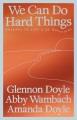 The #1 New York Times bestselling authors and award-winning podcasters Glennon Doyle, Abby Wambach, and Amanda Doyle created We Can Do Hard Things—the guidebook for being alive—to help fellow travelers find their way through life. When you travel through a new country, you need a guidebook. When you travel through love, heartbreak, joy, parenting, friendship, uncertainty, aging, grief, new beginnings—life—you need a guidebook, too. We Can Do Hard Things is the guidebook for being alive. Every day, Glennon Doyle spirals around the same questions: Why am I like this? How do I figure out what I want? How do I know what to do? Why can’t I be happy? Am I doing this right? The harder life gets, the less likely she is to remember the answers she’s spent her life learning. She wonders: I’m almost fifty years old. I’ve overcome a hell of a lot. Why do I wake up every day having forgotten everything I know? Glennon’s compasses are her sister, Amanda, and her wife, Abby. Recently, in the span of a single year, Glennon was diagnosed with anorexia, Amanda was diagnosed with breast cancer, and Abby’s beloved brother died. For the first time, they were all lost at the same time. So they turned toward the only thing that’s ever helped them find their way: deep, honest conversations with other brave, kind, wise people. They asked each other, their dearest friends, and 118 of the world’s most brilliant wayfinders: As you’ve traveled these roads—marriage, parenting, work, recovery, heartbreak, aging, new beginnings—have you collected any wisdom that might help us find our way? As Glennon, Abby, and Amanda wrote down every life-saving answer, they discovered two things: 1. No matter what road we are walking down, someone else has traveled the same terrain. 2. The wisdom of our fellow travelers will light our way. They put all of that wisdom in one place: We Can Do Hard Things—a place to turn when you feel clueless and alone, when you need clarity in the chaos, or when you want wise company on the path of life. We are all life travelers. We don’t have to travel alone. We Can Do Hard Things is our guidebook. Featuring wisdom from: ALOK • Sara Bareilles • Dr. Yaba Blay • Kate Bowler • adrienne maree brown • Brandi Carlile • Brittney Cooper • Brittany Packnett Cunningham • Kaitlin Curtice • Megan Falley • Jane Fonda • Stephanie Foo • Ashley C. Ford • Ina Garten • Roxane Gay • Andrea Gibson • Elizabeth Gilbert • Dr. Orna Guralnik • Tricia Hersey • Justice Ketanji Brown Jackson • Luvvie Ajayi Jones • Dr. Becky Kennedy • Emily Nagoski • Esther Perel • Ai-Jen Poo • Cole Arthur Riley • Dr. Alexandra Solomon • Cheryl Strayed • Sonya Renee Taylor • Ocean Vuong • And many others
- Subjects: Electronic books.; Inspiration & Personal Growth; Happiness; Emotions;
- © 2025., Random House Publishing Group,
-
unAPI
- The Anxious Generation How the Great Rewiring of Childhood Is Causing an Epidemic of Mental Illness [electronic resource] : by Haidt, Jonathan.aut; cloudLibrary;
 From New York Times bestselling coauthor of The Coddling of the American Mind, an essential investigation into the collapse of youth mental health—and a plan for a healthier, freer childhood. “An urgent and provocative read on why so many kids are not okay—and how to course correct." —Adam Grant “A crucial read for parents of children of elementary school age and beyond, who face the rapidly changing landscape of childhood.” —Emily Oster “Every single parent needs to stop what they are doing and read this book immediately."—Johann Hari After more than a decade of stability or improvement, the mental health of adolescents plunged in the early 2010s. Rates of depression, anxiety, self-harm, and suicide rose sharply, more than doubling on many measures. Why? In The Anxious Generation, social psychologist Jonathan Haidt lays out the facts about the epidemic of teen mental illness that hit many countries at the same time. He then investigates the nature of childhood, including why children need play and independent exploration to mature into competent, thriving adults. Haidt shows how the “play-based childhood” began to decline in the 1980s, and how it was finally wiped out by the arrival of the “phone-based childhood” in the early 2010s. He presents more than a dozen mechanisms by which this “great rewiring of childhood” has interfered with children’s social and neurological development, covering everything from sleep deprivation to attention fragmentation, addiction, loneliness, social contagion, social comparison, and perfectionism. He explains why social media damages girls more than boys and why boys have been withdrawing from the real world into the virtual world, with disastrous consequences for themselves, their families, and their societies. Most important, Haidt issues a clear call to action. He diagnoses the “collective action problems” that trap us, and then proposes four simple rules that might set us free. He describes steps that parents, teachers, schools, tech companies, and governments can take to end the epidemic of mental illness and restore a more humane childhood. Haidt has spent his career speaking truth backed by data in the most difficult landscapes—communities polarized by politics and religion, campuses battling culture wars, and now the public health emergency faced by Gen Z. We cannot afford to ignore his findings about protecting our children—and ourselves—from the psychological damage of a phone-based life.
- Subjects: Electronic books.; Mental Health; Teenagers; Stress Management;
- © 2024., Penguin Publishing Group,
-
unAPI
Results 111 to 120 of 121 | « previous | next »