Results 31 to 40 of 43 | « previous | next »
- Bad bad girl : a novel / by Jen, Gish,author.;
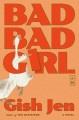 "Gish's mother--Loo Shu-hsin--is born in 1925 to a wealthy Shanghai family where girls are expected to behave and be quiet. Every act of disobedience prompts the same reprimand: "Bad bad girl! You don't know how to talk!" She gets sent to Catholic school, where she is baptized, re-named for St. Agnes, and, unusually for a girl, given an internationally-minded education. Still, her father would say, "Too bad. If you were a boy, you could accomplish a lot." Agnes finds solace in books, reading every night with a flashlight and an English-Chinese dictionary, before announcing her intention to pursue a Ph.D in America. It is 1947, and with the forces of Communist revolution on the horizon, she leaves--never to return. Lonely and adrift in Manhattan, Agnes begins dating Chao-Pei, an engineering student also from Shanghai. While news of their country and their families grows increasingly dire, they set out to make a new life together: marriage, a number one son, a small house in the suburbs. By the time Gish is born, her parents' marriage is unraveling, and her mother, struggling to understand her strong-willed American daughter, is repeating the refrain that punctuated her own childhood: "Bad bad girl! You don't know how to talk!" Bad Bad Girl is a novel about a mother and a daughter forced to reckon with one another across decades of curiosity and ambition, elation and disappointment, intense intimacy and misunderstanding. Spanning continents and generations, this is a rich, heartbreaking portrait of two fierce women locked in a complicated life-long embrace"--
- Subjects: Autobiographical fiction.; Domestic fiction.; Novels.; Chinese American families; Chinese Americans; Chinese diaspora; Emigration and immigration; Intergenerational relations; Interpersonal relations; Mothers and daughters;
- Available copies: 1 / Total copies: 1
-
unAPI
- A Kid from Marlboro Road [electronic resource] : by Burns, Edward.aut; Burns, Edward.nrt; cloudLibrary;
 An Irish-American family comes to life through the eyes of a 13-year-old boy in this debut novel by actor-filmmaker Ed Burns. Immigrants and storytellers, lilting voices and Long Island moxy are all part of this colorful Irish-Catholic community in 1970s New York.A Kid from Marlboro Road opens at a wake, as our twelve-year-old narrator, an aspiring writer, takes in the death of his beloved grandfather, Pop, a larger-than-life figure to him. The overflowing crowd includes sandhogs in their muddy work boots, old Irish biddies in black dresses and cops in uniform, along with the family in mourning. There’s an open casket, the first time he’s seen a dead person. Later, at the bar across the street, he tells a story to the assembled crowd about the day his dad proposed to his mom, and how he almost got beat up by her brothers for it, and then how Pop made him propose twice. His mom calls him “Kneenie,” and with her husband and older son Tommy lost to her, he’s the best thing she’s got. He sees her struggling with depression and is worried his parents might get divorced, but doesn’t know how to help—since like his brother and father before him he knows he’ll also abandon her soon enough.Stories cascade between the prior generation’s colorful origins in the Bronx and the softer world of the of Gibson, the town on Long Island where the family lives now. There are scenes in the Rockaways, at Belmont Race Track, and in Montauk. Out of individual struggles a collective warmth emerges, a certain kind of American story, raucous and joyous.Includes black and white photographs from the author's Irish-American New York family history.
- Subjects: Audiobooks.; Coming of Age; Cultural Heritage; Family Life;
- © 2024., Recorded Books,
-
unAPI
- The Medici return [text (large print)] / by Berry, Steve,1955-author.;
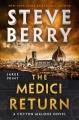 "Cotton Malone is on the hunt for a forgotten 16th century Pledge of Christ - a sworn promise made by Pope Julius II that evidences a monetary debt owed by the Vatican, still valid after five centuries, now worth in the trillions of dollars. But collecting that debt centers around what happened to the famed Medici of Florence - a family that history says died out, without heirs, centuries ago. Two more things also hang in the balance. Who will become the next prime minister of Italy, and who will be the next pope. Finding answers to all three proves difficult until Cotton realizes that everything hinges on when, and if, the Medici return"--
- Subjects: Thrillers (Fiction); Large print books.; Novels.; Malone, Cotton (Fictitious character); Medici, Giuliano de', duca di Nemours, 1479-1516; Medici, House of; Catholic Church; Cardinals; Legal documents; Murder;
- Available copies: 0 / Total copies: 1
-
unAPI
- Ballykissangel. [videorecording] / by Cranitch, Lorcan,1959-; Doyle, Tony,1942-2000.; Hanly, Peter.; Kellegher, Tina.; Toibin, Niall,1929-; BBC Northern Ireland.; Ballykea (Firm); World Productions (Firm : London, England);
 All bar one -- He healeth the sick -- Bread and water -- Par for the course -- The odd couple -- Turf -- It's a family affair -- Rock bottom -- As stars look down -- Births, deaths, and marriages -- It's a man's life -- The final frontier.Tony Doyle, Tina Kellegher, Niall Toibin, Peter Hanly, Lorcan Cranitch.The small mountain town gets a new priest, Father Aidan O'Connell.Canadian Home Video Rating: PG.DVD ; full screen presentation.
- Subjects: Ballykissangel (Ireland : Imaginary Place); Catholic Church; Priests; Television programs; Television programs.; Video recordings for the hearing impaired.;
- © c2010., BBC Video ; Distributed by Warner Home Video,
- Available copies: 1 / Total copies: 1
-
unAPI
- Son of a Critch : a childish Newfoundland memoir / by Critch, Mark,author.;
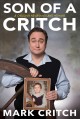 "A heartfelt and outrageously funny memoir about Newfoundland, family, and being the oddest kid in school What could be better than growing up in the 1980s? How about growing up in 1980s Newfoundland, which as Mark Critch will tell you, was more like the 1960s. Critch takes us to where it all began in this tremendously funny and warm look back on his formative years. Growing up in a (very) small town wasn't easy, and Catholic school was a confusing setting that prompted many unexpected adventures. And when your father is the local radio personality, and your mother can't stop talking at all, life at home is always entertaining. Best known as the "roving reporter" for CBC's This Hour Has 22 Minutes, Mark Critch has photo-bombed Justin Trudeau, interviewed Great Big Sea's Alan Doyle (while impersonating Alan Doyle), travelled with political leaders, and crashed White House briefings. But in this hilarious debut, we learn that Critch has been causing trouble his whole life. Son of a Critch will have you longing for life in Canada's most unique province -- even if you've never been there -- and marvelling at how one person's childhood could be so ridiculously funny"--
- Subjects: Biographies.; Critch, Mark.; Critch, Mark; Television actors and actresses; Motion picture actors and actresses; Comedians;
- Available copies: 1 / Total copies: 1
-
unAPI
- Inside the O'Briens [sound recording] / by Genova, Lisa.; Sudduth, Skipp.;
 Read by Skipp Sudduth."From award-winning, New York Times bestselling author and neuroscientist Lisa Genova comes a powerful new novel that does for Huntington's Disease what her debut Still Alice did for Alzheimer's. Joe O'Brien is a forty-four-year-old police officer from the Irish Catholic neighborhood of Charlestown, Massachusetts. A devoted husband, proud father of four children in their twenties, and respected officer, Joe begins experiencing bouts of disorganized thinking, uncharacteristic temper outbursts, and strange, involuntary movements. He initially attributes these episodes to the stress of his job, but as these symptoms worsen, he agrees to see a neurologist and is handed a diagnosis that will change his and his family's lives forever: Huntington's Disease. Huntington's is a lethal neurodegenerative disease with no treatment and no cure. Each of Joe's four children has a 50 percent chance of inheriting their father's disease, and a simple blood test can reveal their genetic fate. While watching her potential future in her father's escalating symptoms, twenty-one-year-old daughter Katie struggles with the questions this test imposes on her young adult life. Does she want to know? What if she's gene positive? Can she live with the constant anxiety of not knowing? As Joe's symptoms worsen and he's eventually stripped of his badge and more, Joe struggles to maintain hope and a sense of purpose, while Katie and her siblings must find the courage to either live a life "at risk" or learn their fate."--Provided by publisher.
- Subjects: Domestic fiction.; Medical fiction.; Audiobooks.; Huntington's disease; Police; Terminally ill;
- © p2015., Simon & Schuster Audio,
- Available copies: 1 / Total copies: 1
-
unAPI
- River of fire : my spiritual journey / by Prejean, Helen,author.;
 In this revelatory, intimate memoir from the author of Dead Man Walking, the nation's foremost leader in efforts to abolish the death penalty shares the story of her growth as a spiritual leader, speaks out about the challenges of the Catholic Church, and shows that joy and religion are not mutually exclusive. Sister Helen Prejean's work as an activist nun, campaigning to educate Americans about the inhumanity of the death penalty, is known to millions worldwide. Less widely known is the evolution of her spiritual journey from praying for God to solve the world's problems to engaging full-tilt in working to transform societal injustices. Sister Helen grew up in a well-off Baton Rouge family that still employed black servants. She joined the Sisters of St. Joseph at the age of eighteen and was in her forties when she had an awakening that her life's work was to immerse herself in the struggle of poor people forced to live on the margins of society. Sister Helen writes about the relationships with friends, fellow nuns, and mentors who have shaped her over the years. In this honest and fiercely open account, she writes about her close friendship with a priest, intent on marrying her, that challenged her vocation in the "new territory of the heart." The final page of River of Fire ends with the opening page of Dead Man Walking, when she was first invited to correspond with a man on Louisiana's death row. River of Fire is a book for anyone interested in journeys of faith and spirituality, doubt and belief, and "catching on fire" to purpose and passion. It is a book, written in accessible, luminous prose, about how to live a spiritual life that is wide awake to the sufferings and creative opportunities of our world.
- Subjects: Autobiographies.; Biographies.; Prejean, Helen.; Sisters of Saint Joseph; Nuns;
- Available copies: 1 / Total copies: 1
-
unAPI
- The book thieves : the Nazi looting of Europe's libraries and the race to return a literary inheritance / by Rydell, Anders,1982-author.; Koch, Henning,1962-translator.; translation of:Rydell, Anders,1982-Boktjuvarna.English.;
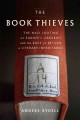 Includes bibliographical references and index.While the Nazi party was being condemned by much of the world for burning books, they were already hard at work perpetrating an even greater literary crime. Through extensive new research that included records saved by the Monuments Men themselves - Anders Rydell tells the untold story of Nazi book theft, as he himself joins the effort to return the stolen books. When the Nazi soldiers ransacked Europe's libraries and bookshops, large and small, the books they stole were not burned. Instead, the Nazis began to compile a library of their own that they could use to wage an intellectual war on literature and history. In this secret war, the libraries of Jews, Communists, Liberal politicians, LGBT activists, Catholics, Freemasons, and many other opposition groups were appropriated for Nazi research, and used as an intellectual weapon against their owners. But when the war was over, most of the books were never returned. Instead many found their way into the public library system, where they remain to this day. Now, Rydell finds himself entrusted with one of these stolen volumes, setting out to return it to its rightful owner. It was passed to him by the small team of heroic librarians who have begun the monumental task of combing through Berlin's public libraries to identify the looted books and reunite them with the families of their original owners. For those who lost relatives in the Holocaust, these books are often the only remaining possession of their relatives they have ever held. And as Rydell travels to return the volume he was given, he shows just how much a single book can mean to those who own it.
- Subjects: Book thefts; Libraries and national socialism; World War, 1939-1945; World War, 1939-1945;
- Available copies: 1 / Total copies: 1
-
unAPI
- We don't know ourselves : a personal history of modern Ireland / by O'Toole, Fintan,1958-author.;
 Includes bibliographical references and index."A celebrated Irish writer's magisterial, brilliantly insightful chronicle of the wrenching transformations that dragged his homeland into the modern world. Fintan O'Toole was born in the year the revolution began. It was 1958, and the Irish government?in despair, because all the young people were leaving?opened the country to foreign investment and popular culture. So began a decades-long, ongoing experiment with Irish national identity. In We Don't Know Ourselves, O'Toole, one of the Anglophone world's most consummate stylists, weaves his own experiences into Irish social, cultural, and economic change, showing how Ireland, in just one lifetime, has gone from a reactionary "backwater" to an almost totally open society-perhaps the most astonishing national transformation in modern history. Born to a working-class family in the Dublin suburbs, O'Toole served as an altar boy and attended a Christian Brothers school, much as his forebears did. He was enthralled by American Westerns suddenly appearing on Irish television, which were not that far from his own experience, given that Ireland's main export was beef and it was still not unknown for herds of cattle to clatter down Dublin's streets. Yet the Westerns were a sign of what was to come. O'Toole narrates the once unthinkable collapse of the all-powerful Catholic Church, brought down by scandal and by the activism of ordinary Irish, women in particular. He relates the horrific violence of the Troubles in Northern Ireland, which led most Irish to reject violent nationalism. In O'Toole's telling, America became a lodestar, from John F. Kennedy's 1963 visit, when the soon-to-be martyred American president was welcomed as a native son, to the emergence of the Irish technology sector in the late 1990s, driven by American corporations, which set Ireland on the path toward particular disaster during the 2008 financial crisis. A remarkably compassionate yet exacting observer, O'Toole in coruscating prose captures the peculiar Irish habit of "deliberate unknowing," which allowed myths of national greatness to persist even as the foundations were crumbling. Forty years in the making, We Don't Know Ourselves is a landmark work, a memoir and a national history that ultimately reveals how the two modes are entwined for all of us"--
- Subjects: Biographies.; Personal narratives.; O'Toole, Fintan, 1958-;
- Available copies: 1 / Total copies: 1
-
unAPI
- The winemaker's wife / by Harmel, Kristin,author.;
 Includes bibliographical references."At the dawn of the Second World War, Ines is the young wife of Michel, owner of the House of Chauveau, a small champagne winery nestled among rolling vineyards near Reims, France. Marrying into a storied champagne empire was supposed to be a dream come true, but Ines feels increasingly isolated, purposely left out of the business by her husband; his chef de cave, Theo; and Theo's wife, Sarah. But these disappointments pale in comparison to the increasing danger from German forces pouring across the border. At first, it's merely the Nazi weinfuhrer coming to demand the choicest champagne for Hitler's cronies, but soon, there are rumors of Jewish townspeople being rounded up and sent east to an unspeakable fate. The war is on their doorstep, and no one in Ines's life is safe--least of all Sarah, whose father is Jewish, or Michel, who has recklessly begun hiding munitions for the Resistance in the champagne caves. Ines realizes she has to do something to help. Sarah feels as lost as Ines does, but she doesn't have much else in common with Michel's young wife. Ines seems to have it made, not least of all because as a Catholic, she's "safe." Sarah, on the other hand, is terrified about the fate of her parents--and about her own future as the Germans begin to rid the Champagne region of Jews. When Sarah makes a dangerous decision to follow her heart in a desperate bid to find some meaning in the ruin, it endangers the lives of all those she cares about--and the champagne house they've all worked so hard to save. In the present, Liv Kent has just lost her job--and her marriage. Her wealthy but aloof Grandma Edith, sensing that Liv needs a change of scenery before she hits rock bottom, insists that Liv accompany her on a trip to France. But the older woman has an ulterior motive--and some difficult but important information to share with her granddaughter. As Liv begins to uncover long-buried family secrets, she finds herself slowly coming back to life. When past and present intertwine at last, she may finally find a way forward, along a difficult road that leads straight to the winding caves beneath the House of Chauveau. Perfect for fans of Kristin Hannah's The Nightingale and Kate Quinn's The Alice Network, The Winemaker's Wife is an evocative and gorgeously wrought novel that examines how the choices we make in our darkest hours can profoundly change our lives--and how hope can come from the places we least expect"--
- Subjects: Historical fiction.; Family secrets; World War, 1939-1945;
- Available copies: 1 / Total copies: 1
-
unAPI
Results 31 to 40 of 43 | « previous | next »