Results 101 to 110 of 111 | « previous | next »
- Billion dollar burger : inside big tech's race for the future of food / by Purdy, Chase,author.;
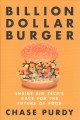 Includes bibliographical references and index."The riveting story of the entrepreneurs and renegades fighting to bring lab-grown meat to the world. The trillion-dollar meat industry is one of our greatest environmental hazards; it pollutes more than all the world's fossil-fuel-powered cars. Global animal agriculture is responsible for deforestation, soil erosion, and more emissions than air travel, paper mills, and coal mining combined. It also, of course, depends on the slaughter of more than 60 billion animals per year, a number that is only increasing as the global appetite for meat swells. But a band of doctors, scientists, activists, and entrepreneurs have been racing to end animal agriculture as we know it, hoping to fulfill a dream of creating meat without ever having to kill an animal. In the laboratories of Silicon Valley companies, Dutch universities, and Israeli startups, visionaries are growing burgers and steaks from microscopic animal cells and inventing systems to do so at scale--allowing us to feed the world without slaughter and environmental devastation. Drawing from exclusive and unprecedented access to the main players, from polarizing activist-turned-tech CEO Josh Tetrick to lobbyists and regulators on both sides of the issue, Billion Dollar Burger follows the people fighting to upend our food system as they butt up against the entrenched interests fighting viciously to stop them. The stakes are monumentally high: cell-cultured meat is the best hope for sustainable food production, a key to fighting climate change, a gold mine for the companies that make it happen, and an existential threat for the farmers and meatpackers that make our meat today. Are we ready?"--
- Subjects: Meat; Meat industry and trade; Meat substitutes.;
- Available copies: 1 / Total copies: 1
-
unAPI
- How the world really works : the science behind how we got here and where we're going / by Smil, Vaclav,author.;
 Includes bibliographical references and index."An essential analysis of the modern science and technology that makes our twenty-first century lives possible--a scientist's investigation into what science really does, and does not, accomplish. We have never had so much information at our fingertips and yet most of us don't know how the world really works. This book explains seven of the most fundamental realities governing our survival and prosperity. From energy and food production, through our material world and its globalization, to risks, our environment and its future, How the World Really Works offers a much-needed reality check--because before we can tackle problems effectively, we must understand the facts. In this ambitious and thought-provoking book we see, for example, that globalization isn't inevitable--the foolishness of allowing 70 per cent of the world's rubber gloves to be made in just one factory became glaringly obvious in 2020--and that our societies have been steadily increasing their dependence on fossil fuels, such that any promises of decarbonization by 2050 are a fairy tale. For example, each greenhouse-grown supermarket-bought tomato has the equivalent of five tablespoons of diesel embedded in its production, and we have no way of producing steel, cement or plastics at required scales without huge carbon emissions. Ultimately, Smil answers the most profound question of our age: are we irrevocably doomed or is a brighter utopia ahead? Compelling, data-rich and revisionist, this wonderfully broad, interdisciplinary guide finds faults with both extremes. Looking at the world through this quantitative lens reveals hidden truths that change the way we see our past, present and uncertain future"--
- Subjects: Science and civilization.; Technology and civilization.; Science; Technological innovations;
- Available copies: 1 / Total copies: 1
-
unAPI
- It stops here : standing up for our lands, our waters, and our people / by George, Rueben,author.; Simpson, Michael(Lecturer),author.;
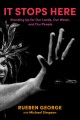 "A personal account of one man's confrontation with colonization that illuminates the philosophy and values of a First Nation threatened by the Trans Mountain pipeline. It Stops Here is the story of the spiritual, cultural, and political resurgence of a nation taking action to reclaim their lands, waters, law, and food systems in face of colonization. The book recounts the intergenerational struggle of the Tsleil-Waututh to overcome the harms of colonization and the powerful stance they have taken against the expansion of the Trans Mountain Pipeline--a fossil fuel megaproject that would triple the capacity of tar sands bitumen piped to tidewater on their unceded territory and result in a sevenfold increase in oil tankers moving through their waters. The book provides a firsthand account of this resurgence as told by one of the most prominent leaders of the widespread opposition to the Trans Mountain Pipeline expansion--Rueben George of the Tsleil-Waututh Nation. He has devoted more than a decade of his life to fighting this project and shares stories about his family's deep ancestral connections to these waters that have provided the Tsleil-Waututh with a rich abundance of foods and medicines since time immemorial. Despite the systematic attempts at cultural genocide enacted by the colonial state, Rueben recounts how key leaders of the community, such as his grandfather, Chief Dan George, always taught the younger generations to be proud of who they were and to remember the importance of their connection to the inlet. Part memoir, part call to action, It Stops Here urges policy makers to prioritize sacred territory over oil profits and insists that colonial Canada change its perspective from bending natural resources to their will to respecting this territory and those who inhabit it."--
- Subjects: Autobiographies.; Biographies.; Personal narratives.; George, Rueben; George, Rueben.; Petroleum pipelines; Social justice; First Nations activists; First Nations; First Nations; First Nations;
- Available copies: 1 / Total copies: 1
-
unAPI
- Free the land : how we can fight poverty and climate chaos / by Lim, Audrea,author.;
 Includes bibliographical references and index."An eye-opening examination of how treating land as a source of profit has a massive impact on racial inequality and the housing, gentrification, and environmental crises. Climate change, gentrification, racial discrimination, and corporate greed are some of the most urgent problems facing our society. They are traditionally treated as unrelated issues, but they all share a common root: the ownership of land. Environmental journalist Audrea Lim began to notice these connections when she reported on the Native communities leading the fight against oil drilling on their lands in the Canadian tar sands near her hometown of Calgary, but before long, she saw the essential role of land commodification and private ownership everywhere she looked: in foreclosure-racked suburbs and gentrifying cities like New York City; among poor, small farmers struggling to keep their businesses afloat; and in low-income communities attempting to resist mines and industrial development on their lands, only to find that their voices counted less than those of shareholders living thousands of miles away. Free the Land is a captivating and beautifully rendered look at the ways that our relationship to the land is the core cause of the most pressing justice issues in North America. Lim expertly weaves together seemingly disparate themes into a unified theory of social justice, describes how the land ownership system developed over the centuries, and presents original reporting from a wide range of activists and policy makers to illustrate the profound impact it continues to have on our society today. Ultimately, this book offers a message of hope: by approaching these socioeconomic issues holistically, we can begin to imagine just alternatives to fossil-fueled capitalism, new ways to build community, and a more sustainable, equitable world"--
- Subjects: Climatic changes.; Land use; Race discrimination.;
- Available copies: 1 / Total copies: 1
-
unAPI
- Goliath's curse : the history and future of societal collapse / by Kemp, Luke,author.;
 Includes bibliographical references and index."A radical retelling of human history through collapse -- from the dawn of our species to the urgent existential threats of the twenty-first century and beyond. Why do civilisations collapse? Is human progress possible? Are we approaching our endgame? For the first 200,000 years of human history, hunter-gathering Homo sapiens lived in fluid, egalitarian civilizations that thwarted any individual or group from ruling permanently. Then, around 12,000 years ago, that began to change. As we reluctantly congregated in the first farms and cities, people began to rely on novel lootable resources like grain and fish for their daily sustenance. And when more powerful weapons became available, small groups began to seize control of these valuable commodities. This inequality in resources soon tipped over into inequality in power, and we started to adopt more primal, hierarchical forms of organization. Power was concentrated in masters, kings, pharaohs and emperors (and ideologies were born to justify their rule). Goliath-like states and empires -- with vast bureaucracies and militaries -- carved up and dominated the globe. What brought them down? Whether in the early cities of Cahokia in North America or Tiwanaku in South America, or the sprawling empires of Egypt, Rome and China, it was increasing inequality and concentrations of power that hollowed these Goliaths out before an external shock brought them crashing down. These collapses were written up as apocalyptic, but in truth they were usually a blessing for most of the population. Now we live in a single global Goliath. Growth obsessed, extractive institutions like the fossil fuel industry, big tech and military-industrial complexes rule our world and produce new ways of annihilating our species, from climate change to nuclear war. Our systems are now so fast, complex and interconnected that a future collapse will likely be global, swift and irreversible. All of us now face a choice -- we must learn to democratically control Goliath, or the next collapse may be our last"--
- Subjects: Civilization.; Regression (Civilization); Regression (Civilization); Social change.;
- Available copies: 0 / Total copies: 1
-
unAPI
- Into the clear blue sky : the path to restoring our atmosphere / by Jackson, Rob,1961-author.;
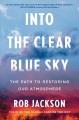 Includes bibliographical references and index."One of the world's leading climate scientists, a superb storyteller, shares his hopeful and attainable vision for restoring the atmosphere and ending the climate crisis within our lifetime.Climate change is here. From the millions displaced by the floods in Pakistan to California and Canadian towns incinerated by wildfires, we are experiencing the anguish that climate change causes. Fossil fuels are making the planet unlivable, and they are deadly. We know that we must cut emissions if we are going to limit the catastrophes, but is that enough? In Into the Clear Blue Sky, climate scientist and chair of the Global Carbon Project Rob Jackson explains that we need to redefine our goals. As he argues here, we shouldn't only be trying to stabilize the Earth's temperature at some arbitrary value. Instead, we can restore the atmosphere itself in a lifetime -- and this should be our moral duty. Restoring the atmosphere means reducing the amount of greenhouse gases in the air to pre-industrial levels -- starting with super-potent methane -- to heal the harm we have done. Emissions must be cut, first and foremost. But to safeguard a livable planet for future generations, we must repair the damage we have caused. Jackson introduces us to the brilliant leaders and innovators behind some of the boldest and game-changing climate solutions under development. When it comes to greenhouse gas mitigation, our choices matter, because it is easier to stop emissions from happening than to remove greenhouse gases from the air later. But while mitigation is crucial, no number of solar panels, electric cars, and veggie burgers alone will be enough to halt climate change. Decades of inaction have convinced Jackson that we need to remove greenhouse gases from the air using everything from nature to cutting-edge technologies. Into the Clear Blue Sky is a heart- and mind-changing book. Guided by one of the leading scientists in this fight and a deeply gifted storyteller, we learn why we should all feel hopeful. One way or another, we will restore the planet together. The question is how, and how long will it take?"--
- Subjects: Climate change mitigation.; Climatic changes.; Global warming.;
- Available copies: 1 / Total copies: 1
-
unAPI
- Hubris maximus : the shattering of Elon Musk / by Siddiqui, Faiz,author.;
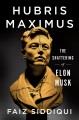 Includes bibliographical references and index."The rise, fall, and revival of the Caesar of Silicon Valley. Elon Musk has cast himself as the savior of humanity, an altruistic force whose fortune is tied to noble pursuits from halting our dependence on fossil fuels to colonizing Mars. Once frequently heralded as a modern-day Edison, Musk has taken up a new place in the public consciousness with his growing desire to disrupt not just the automotive and space industries but the policies that shape our nation, placing him at the center of America's most complex undertakings in manufacturing, politics, and defense and technology, even as his increasingly erratic personal behavior has raised questions about his stability and judgement. Musk famously leads his companies from a bully pulpit, eroding guardrails and cutting through red tape whenever possible with little regard for the fallout as long as it serves his larger goals. Many in his orbit have seen their lives upended or their careers throttled by believing in his utopian vision. As the scale of the wagers he makes with his fortune and concerns about his credibility have grown in recent years, he alternately seems to be in complete command or on the verge of a meltdown. Yet in the long run, he has only become wealthier, and now the stakes have risen. Thanks to astute political maneuvering, Musk is no longer limited to gambling with a company's bottom line or the livelihoods of his workers; he is poised to apply his uncompromising approach to business to the foundational rules and regulations that hold our society together. At a moment when America's tech gods are more influential than ever, Hubris Maximus is a cautionary tale about the pitfalls of lionizing magnetic leaders. Washington Post journalist Faiz Siddiqui offers a gripping, detailed portrait of a singularly messy and lucrative period in Musk's career, as well as a case study in the power of using one's platform to shape the public narrative in a world that can't turn away from its screens. --Pubisher's website.
- Subjects: Biographies.; Personal narratives.; Musk, Elon.; Businessmen; Businessmen;
- Available copies: 1 / Total copies: 1
-
unAPI
- Hurricane lizards and plastic squid : the fraught and fascinating biology of climate change / by Hanson, Thor,author.;
 Includes bibliographical references and index."In his three previous books-Feathers, The Triumph of Seeds, and Buzz-Thor Hanson has taken his readers on unforgettable journeys into nature, rendered with great storytelling, the soul of a poet, and the insight of a biologist. In this new book, he is doing it again, but exploring one of the most vital scientific and cultural issues of our time: climate change. As a young biologist, Hanson by his own admission watched with some detachment as our warming planet presented plants and animals with an ultimatum: change or face extinction. But his detachment turned to both concern and awe, as he observed the remarkable narratives of change playing out in each plant and animal he studied. In Hurricane Lizards and Plastic Squid, Hanson tells the story of how nature-both plants and animals, from beech trees to beetles-are meeting the challenges of rapid climate change head-on, adjusting, adapting, and sometimes noticeably evolving. Brown pelicans are fleeing uphill, seeking out new lives in the mountains. Gorillas in Uganda are turning to new food sources, such as eucalyptus trees (which humans only imported to Africa in the past several decades), as their old sources wain. Auklets, a little sea bird, aren't so lucky: changes in the lifecycles of their primary food source means they return at specific times of year to oceanic feeding grounds expecting plankton blooms that are no longer there. As global warming transforms and restructures the ecosystems in which these animals and others live, Hanson argues, we are forced to conclude that climate change will not have just one effect: Some transformations are beneficial. Others, and perhaps most, are devastating, wiping out entire species. One thing is constant: with each change an organism undergoes, the delicate balance of interdependent ecosystems is tipped, forcing the evolution of thousands more species, including us. To understand how, collectively, these changes are shaping the natural world and the future of life, Hanson looks back through deep time, examining fossil records, pollen, and even the tooth enamel of giant wombats and mummified owl pellets. Together, these records of our past tell the story of ancient climate change, shedding light on the challenges faced by today's species, the ways they will respond, and how these strategies will determine the fate of ecosystems around the globe. Ultimately, the story of nature's response to climate change is both fraught and fascinating, a story of both disaster and resilience, and, sometimes, hope. Lyrical and thought-provoking, Hurricane Lizards and Plastic Squid is poised to transform the conversation around climate change, shifting the focus from humans to the lattice of life, of which humans are just a single point"--
- Subjects: Adaptation (Biology); Bioclimatology.; Biotic communities.; Climatic changes.; Global environmental change.;
- Available copies: 1 / Total copies: 1
-
unAPI
- Tino, le dinosaure à plumes / by Randell, Beverley,1931-; Spiby, Ben.;
 LSC
LSC- Subjects: Oiseaux fossiles; Dinosaures; Birds, Fossil; Dinosaurs;
- © c2004., Groupe Beauchemin,
- Available copies: 1 / Total copies: 1
-
unAPI
- Le monde des roches et des minéraux / by Dennie, Devin.;
-

- Subjects: Roches; Minéraux; Fossiles; Fossils; Roches; Minéraux; Fossiles; French language materials.; Fossils;
- Available copies: 0 / Total copies: 1
-
unAPI
Results 101 to 110 of 111 | « previous | next »