Results 11 to 12 of 12 | « previous
- Data cartels : the companies that control and monopolize our information / by Lamdan, Sarah,author.;
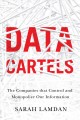 Includes bibliographical references and index."In our digital world, data is power, and information hoarders reign supreme. The practices of these digital pillagers are analogous to those of cartels--they use intimidation, aggression, and force to maintain control and power. Sarah Lamdan brings us into the unregulated underworld of the "data cartels," demonstrating how the entities mining, hoarding, commodifying, and selling our data and informational resources perpetuate social inequalities and threaten the democratic sharing of knowledge. The companies at the center of this book are not household names like Google. They fly under the radar and self-identify as "data analytics" or "business solutions" operations. These companies supply the digital lifeblood that flow through the circulatory system of the internet. With their control over data, they can prevent the free flow of information to places where it is needed, and simultaneously distribute private information to predatory entities. Just a few companies dominate most of our critical informational resources, from scientific research and financial data to the law. They are also data brokers, selling our personal data to law enforcement and other government agencies that determine whether we should be eligible for social services, and they sell "risk" products that insurance companies, employers, landlords, and healthcare systems use to make decisions. Alarmingly, everything they're doing is perfectly legal. Ranging from small information firms to billion-dollar data giants like Thomson Reuters and RELX Group, these companies masterfully exploit outdated information and privacy laws, curating online information in a way that amplifies digital racism and targets marginalized communities. In this book, Lamdan contends that privatization and tech exceptionalism have prevented us from creating effective legal regulation. Lack of legal intervention has allowed oversized information oligopolies to coalesce. In addition to specific legal and market-based solutions, Lamdan calls for treating information like a public good and creating digital infrastructure that supports our democratic ideals"--
- Subjects: Antitrust law; Cartels; Data protection; Freedom of information; Information services industry; Information services industry;
- Available copies: 1 / Total copies: 1
-
unAPI
- The coming wave : technology, power, and the twenty-first century's greatest dilemma / by Suleyman, Mustafa,author.; Bhaskar, Michael,author.;
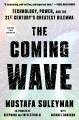 Includes bibliographical references and index."A stark and urgent warning on the unprecedented risks that a wave of fast-developing technologies poses to global order, and how we might contain them while we have the chance--from a cofounder of the pioneering AI company DeepMind. Imagine a world in which anyone with a $20,000 desktop DNA synthesizer could develop and unleash a deadly virus. Imagine an undetectable deepfake video of a U.S. president making a racial slur racing across the internet on the eve of an election. Imagine terrorists or paramilitaries stockpiling autonomous weapons designed to make their own decisions about when to engage. As cofounder of DeepMind, the pioneering AI company now owned by Google, Mustafa Suleyman has witnessed firsthand just how rapidly our technology is advancing--and how flawed our approaches to grappling with these changes are. The coming decades, he argues, will be defined by a burst of innovation, an inevitable wave of powerful, fast-proliferating new technologies across fields like synthetic biology, artificial intelligence, and quantum computing. Driven forward by immense strategic and financial incentives, these breakthroughs will solve huge challenges and create vast wealth--but upheaval, too, on a once unimaginable scale. Will humankind make it through the narrow corridor between dystopia and catastrophe? In The Coming Wave, Suleyman shows how this new technological super-wave fits a historical pattern of innovation and proliferation, while departing from it in key ways: namely, the speed of change, the breadth of risks, and the wave's potential to democratize access to dangerous, world-altering power. The cumulative risks threaten the very nation state, humanity's centuries' old "grand bargain" of living under centralized authority in exchange for security. As our fragile governments sleepwalk into catastrophe, humanity is left in an existential bind, with techno-authoritarianism on one side and even more catastrophic outcomes, like societal collapse, on the other. We are about to cross a critical threshold in the history of our species. In this groundbreaking book from the ultimate AI insider, Suleyman firmly establishes "the containment problem"--or the challenge of maintaining human control over dangerous technologies--as the essential dilemma of our age, showing that radical steps must be taken if we are to live alongside technology of once unimaginable power"--
- Subjects: Artificial intelligence; Information technology;
- Available copies: 0 / Total copies: 1
-
unAPI
Results 11 to 12 of 12 | « previous