Results 61 to 70 of 143 | « previous | next »
- The anxious generation [sound recording] : how the great rewiring of childhood is causing an epidemic of mental illness / by Haidt, Jonathan,author,narrator.; Pratt, Sean,narrator.; Blackstone Publishing,publisher.;
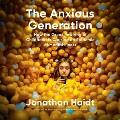 Read by Sean Pratt, Jonathan Haidt."From New York Times bestselling coauthor of The Coddling of the American Mind, an essential investigation into the collapse of youth mental health-and a plan for a healthier, freer childhood. After more than a decade of stability or improvement, the mental health of adolescents plunged in the early 2010s. Rates of depression, anxiety, self-harm, and suicide rose sharply, more than doubling on most measures. Why? In The Anxious Generation, social psychologist Jonathan Haidt lays out the facts about the epidemic of teen mental illness that hit many countries at the same time. He then investigates the nature of childhood, including why children need play and independent exploration to mature into competent, thriving adults. Haidt shows how the "play-based childhood" began to decline in the 1980s, and how it was finally wiped out by the arrival of the "phone-based childhood" in the early 2010s. He presents more than a dozen mechanisms by which this "great rewiring of childhood" has interfered with children's social and neurological development, covering everything from sleep deprivation to attention fragmentation, addiction, loneliness, social contagion, social comparison, and perfectionism. He explains why social media damages girls more than boys and why boys have been withdrawing from the real world into the virtual world, with disastrous consequences for themselves, their families, and their societies. Most important, Haidt issues a clear call to action. He diagnoses the "collective action problems" that trap us, and then proposes four simple rules that might set us free. He describes steps that parents, teachers, schools, tech companies, and governments can take to end the epidemic of mental illness and restore a more humane childhood. Haidt has spent his career speaking truth backed by data in the most difficult landscapes-communities polarized by politics and religion, campuses battling culture wars, and now the public health emergency faced by Gen Z. We cannot afford to ignore his findings about protecting our children-and ourselves-from the psychological damage of a phone-based life"--
- Subjects: Audiobooks.; Child development; Child mental health; Children; Internet and children; Social media;
- Available copies: 1 / Total copies: 1
-
unAPI
- Candace Pert : genius, greed, and madness in the world of science / by Ryckman, Pamela,author.;
 Includes bibliographical references."Candace Pert stood at the dawn of three revolutions: the women's movement, integrative health, and psychopharmacology. A scientific prodigy, she was 30 years ahead of her time, preaching a holistic, interdisciplinary approach to healthcare and medicine long before yoga hit the mainstream and "wellness" took root in our vernacular. Her bestselling book Molecules of Emotion made her the mother of the Mind/Body Revolution, launching a paradigm shift in medicine. Deepak Chopra credits her with creating his career, and he said as much in his eulogy at her funeral. Candace began her career as an unbridled maverick. In 1972, as a 26-year-old graduate student at Johns Hopkins, she discovered the opiate receptor, revolutionizing her field and enabling pharmacologists to design new classifications of drugs from Prozac to Viagra to Percocet and OxyContin. The tragic irony of her breakthrough, touted as the first step to end heroin addiction, is that it helped spawn a virulent epidemic of drug dependence. Facing the largest public health crisis of the 21st century, Candace was incensed that the Hippocratic oath-"first, do no harm"--would succumb to greed, and as witness to this abuse of power, she was one of few scientists courageous enough to protest. Later, as Chief of Brain Biochemistry at the National Institutes of Health, Candace created Peptide T, the non-toxic treatment for HIV featured in Dallas Buyers Club. As the AIDS pandemic raged, triggering panic across Reagan-era America, the U.S. government poured massive amounts of money into finding a cure, sparking a battle among scientists for funding and power. Bested by rivals with competing drugs yet desperate to help, Candace went rogue, becoming a lynchpin in the black market for Peptide T. After a scandalous departure from her tenured position at the NIH, Candace launched a series of private companies with Michael Ruff, her second husband and collaborator. Naïve to the world of business, she was manipulated by investors keen to wrest control of her discoveries. But Candace too became tainted, believing that her noble ends would justify devious means. Like a mythic hero, she succumbed to a fatal flaw, and her greatest strengths--singularity of purpose and blind faith in her own virtuosity--would prove to be her undoing"--
- Subjects: Biographies.; Pert, Candace B., 1946-2013.; Feminists; Integrative medicine; Psychopharmacologists;
- Available copies: 1 / Total copies: 1
-
unAPI
- Healing the modern brain : nine tenets to build mental fitness and revitalize your mind / by Ramsey, Drew,author.;
 Includes bibliographical references and index.A doctor presents a holistic approach to mental fitness, combining science and clinical practice to help nurture mental health and heal conditions like depression and anxiety amidst the challenges of modern life.
- Subjects: Self-help publications.; Brain; Brain.; Happiness.; Mental health.; Mental illness; Self-actualization (Psychology);
- Available copies: 1 / Total copies: 1
-
unAPI
- Great society : a new history / by Shlaes, Amity,author.;
 Includes bibliographical references and index." In the 1960s, Americans sought the same goals many seek now: an end to poverty, higher standards of living for the middle class, a better environment and more access to health care and education. Then, too, we debated socialism and capitalism, public sector reform versus private sector advancement. Time and again, whether under John F. Kennedy, Lyndon Johnson, or Richard Nixon, the country chose the public sector. Yet the targets of our idealism proved elusive. What's more, Johnson's and Nixon's programs shackled millions of families in permanent government dependence. Ironically, Shlaes argues, the costs of entitlement commitments made a half century ago preclude the very reforms that Americans will need in coming decades."--
- Subjects: Johnson, Lyndon B. (Lyndon Baines), 1908-1973.; Nixon, Richard M. (Richard Milhous), 1913-1994.; Nineteen sixties.; Public housing;
- Available copies: 1 / Total copies: 1
-
unAPI
- Aftershocks : pandemic politics and the end of the old international order / by Kahl, Colin H.,1971-author.; Wright, Thomas J.,author.;
 Includes bibliographical references and index."The COVID-19 crisis is the greatest shock to world order since Worlwd War II. Millions have been infected and killed. The economic crash caused by the pandemic is the worst since the Great Depression, with the International Monetary Fund estimating that it will cost over $9 trillion of global wealth in the next few years. Many will be left impoverished and hungry. Fragile states will be further hollowed out, creating conditions ripe for conflict and mass displacement. Meanwhile, international institutions and alliances already under strain before the pandemic are teetering, while the United States and China, already at loggerheads before the crisis, are careening toward a new Cold War. China's secrecy and assertiveness have shattered hopes that it will become a responsible stakeholder in the international order. Colin Kahl and Thomas Wright's Aftershocks is both a riveting journalistic account of one of the strangest years on record and a comprehensive analysis of the pandemic's ongoing impact on the foundational institutions and ideas that have shaped the modern world. This is the first crisis in decades without a glimmer of American leadership and it shows -- there has been no international cooperation on a quintessential global challenge. Every country has followed its own path -- nationalizing supplies, shutting their borders, and largely ignoring the rest of the world. The international order the United States constructed seven decades ago is in tatters, and the world is adrift. None of this came out of the blue. Public health experts and intelligence analysts had warned for a decade that a pandemic of this sort was inevitable. The crisis broke against a global backdrop of rising nationalism, backsliding democracy, declining public trust in governments, mounting rebellion against the inequalities produced by globalization, resurgent great power competition, and plummeting international cooperation. And yet, there are some signs of hope. The COVID-19 crisis reminds us of our common humanity and shared fate. The public has, for the most part, responded stoically and with kindness. Some democracies -- South Korea, Taiwan, Germany, New Zealand, among others -- have responded well. America may emerge from the crisis with a new resolve to deal with non-traditional threats, like pandemic disease, and a new demand for effective collective action with other democratic nations. America may also finally be forced to come to grips with our nation's inadequacies, and to make big changes at home and abroad that will set the stage for opportunities the rest of this century holds. But one thing is certain: America and the world will never be the same again"--
- Subjects: COVID-19 (Disease); Epidemics; Epidemics;
- Available copies: 1 / Total copies: 1
-
unAPI
- The Anxious Generation How the Great Rewiring of Childhood Is Causing an Epidemic of Mental Illness [electronic resource] : by Haidt, Jonathan.aut; cloudLibrary;
 From New York Times bestselling coauthor of The Coddling of the American Mind, an essential investigation into the collapse of youth mental health—and a plan for a healthier, freer childhood. “An urgent and provocative read on why so many kids are not okay—and how to course correct." —Adam Grant “A crucial read for parents of children of elementary school age and beyond, who face the rapidly changing landscape of childhood.” —Emily Oster “Every single parent needs to stop what they are doing and read this book immediately."—Johann Hari After more than a decade of stability or improvement, the mental health of adolescents plunged in the early 2010s. Rates of depression, anxiety, self-harm, and suicide rose sharply, more than doubling on many measures. Why? In The Anxious Generation, social psychologist Jonathan Haidt lays out the facts about the epidemic of teen mental illness that hit many countries at the same time. He then investigates the nature of childhood, including why children need play and independent exploration to mature into competent, thriving adults. Haidt shows how the “play-based childhood” began to decline in the 1980s, and how it was finally wiped out by the arrival of the “phone-based childhood” in the early 2010s. He presents more than a dozen mechanisms by which this “great rewiring of childhood” has interfered with children’s social and neurological development, covering everything from sleep deprivation to attention fragmentation, addiction, loneliness, social contagion, social comparison, and perfectionism. He explains why social media damages girls more than boys and why boys have been withdrawing from the real world into the virtual world, with disastrous consequences for themselves, their families, and their societies. Most important, Haidt issues a clear call to action. He diagnoses the “collective action problems” that trap us, and then proposes four simple rules that might set us free. He describes steps that parents, teachers, schools, tech companies, and governments can take to end the epidemic of mental illness and restore a more humane childhood. Haidt has spent his career speaking truth backed by data in the most difficult landscapes—communities polarized by politics and religion, campuses battling culture wars, and now the public health emergency faced by Gen Z. We cannot afford to ignore his findings about protecting our children—and ourselves—from the psychological damage of a phone-based life.
- Subjects: Electronic books.; Mental Health; Teenagers; Stress Management;
- © 2024., Penguin Publishing Group,
-
unAPI
- It's perfectly normal : a book about changing bodies, growing up, sex, and sexual health / by Harris, Robie H.; Emberley, Michael.;
 This book is part of our Book Sanctuary collection. A Book Sanctuary is a physical or digital space that actively protects the freedom to read. It provides shelter and access to endangered books. Launched by Chicago Public Library in 2022, The Book Sanctuary initiative brings attention to challenged titles, and commits to making these books accessible. Innisfil ideaLAB & Library's Book Sanctuary Collection represents books that have been challenged, censored or removed from a public library or school in North America. More than 50 adult, teen, and children's books are in our collection and are available for browsing and borrowing in our branches and online. Explore the collection to learn more about why these books were challenged."For age 10 and up"--Cover.LSC
- Subjects: Banned book sanctuary.; Sex instruction for children; Sex instruction for teenagers; Sexual health;
- © 2014., Candlewick Press,
- Available copies: 3 / Total copies: 3
-
unAPI
- Diet, drugs, and dopamine : the new science of achieving a healthy weight / by Kessler, David A.,1951-author.;
 Includes bibliographical references and index."From the New York Times bestselling author of The End of Overeating comes an illuminating understanding of body weight, including the role of the latest weight loss drugs, and the possibility of changing our health forever. The struggle is universal: we work hard to lose weight, only to find that it slowly creeps back. In America, body weight has become a pain point shrouded in self-recrimination and shame, not to mention bias from the medical community. For many, this battle not only takes a mental toll but also becomes a physical threat: three-quarters of American adults struggle with weight-related health conditions, including high blood pressure, heart disease, and diabetes. We know that diets don't work, and yet we also know that excess weight starves us of years and quality of life. Where do we go from here? In Diet, Drugs, and Dopamine, former FDA Commissioner Dr. David A. Kessler unpacks the mystery of weight in the most comprehensive work to date on this topic, giving readers the power to dramatically improve their health. Kessler, who has himself struggled with weight, suggests the new class of GLP-1 weight loss drugs have provided a breakthrough: they have radically altered our understanding of weight loss. They make lasting change possible, but they also have real disadvantages and must be considered as part of a comprehensive approach together with nutrition, behavior, and physical activity. Critical to this new perspective is the insight that weight-loss drugs act on the part of the brain that is responsible for cravings. In essence, the drugs tamp down the addictive circuits that overwhelm rational decision-making and quiet the "food noise" that distracts us. Identifying these mechanisms allows us to develop a strategy for effective long-term weight loss, and that begins with naming the elephant in the room: ultraformulated foods are addictive. Losing weight is a process of treating addiction. In this landmark book, one of the nation's leading public health officials breaks taboos around this fraught conversation, giving readers the tools to unplug the brain's addictive wiring and change their relationship with food. Dr. Kessler cautions that drugs, on their own, pose serious risks and are not a universal solution. But with this new understanding of the brain-body feedback loop comes new possibilities for our health and freedom from a lifelong struggle. Eye-opening, provocative, and rigorous, this book is a must-read for anyone who has ever struggled to maintain their weight-which is to say, everyone"-- Provided by publisher.
- Subjects: Reducing diets.; Weight loss preparations.; Weight loss;
- Available copies: 0 / Total copies: 1
-
unAPI
- Mind the science : saving your mental health from the wellness industry / by Stea, Jonathan N.,author.;
 Includes bibliographical references and index."A clinical psychologist who regularly deals with some of society's most vulnerable exposes and debunks the predatory pseudoscience and grift of the multi-trillion-dollar wellness industry and points us towards a better way to take care of our mental health. Can the unbroken gaze of a lone man on a stage in front of hundreds of people truly alleviate their mental distress? Can Berlin Wall pills or a coffee enema cure depression? Can we improve our mental health with past-life regression therapy, cold-water shock therapy, rebirthing therapy ... try none of the above. Wellness grifters and alternative-health snake oil salesmen are everywhere these days, and when our medical systems are under stress (and we are, too!) these costly purveyors of false hope are worse than a waste of money, they can lead us to delay badly needed care from real professionals, exacerbate our conditions and, in the most tragic of cases, even kill us. Today, people looking to care for their mental health face a market with at least 600 "brands" of psychotherapy-and counting. Most are invalid, and many could be harmful. There exist countless unregulated providers of mental-health services in the $4.5 trillion USD wellness industry and alternative medicine community who market themselves as "life coaches," "wellness consultants," and-depending on particular countries and jurisdictions-other various non-legally-protected titles, such as "therapists," "psychotherapists," "counselors," and "practitioners." Looking to exploit people's financial and emotional vulnerabilities, anyone can call themselves a "therapist" without a license. The world of mental healthcare is very much caveat emptor: buyer beware. Having seen so many of his patients hurt by the pseudoscience circulating in the industry, Dr. Jonathan N. Stea is on a mission to expose its harm and protect the public from pseudoscientific mental-health misinformation. In a landscape of rampant burnout and at a time when mental health concerns are at a fever pitch, Mind the Science provides hope and real information to those who have been touched by mental illness, have been misled by false marketing, or are simply curious about the relationship between science and mental health."--
- Subjects: Communication in medicine.; Electronic information resource literacy.; Mental health education.; Mental health;
- Available copies: 1 / Total copies: 1
-
unAPI
- The China study : the most comprehensive study of nutrition ever conducted and the startling implications for diet, weight loss and long-term health / by Campbell, T. Colin,1934-author.; Campbell, Thomas M.,II,author.;
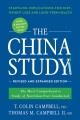 Includes bibliographical references (pages 389-438) and index.This work presents the results of a large study of diet and death rates from cancer in adults across China and Taiwan and explains the study's significance and what it reveals about the implications of poor nutrition. While revealing that proper nutrition can have a dramatic effect on reducing and reversing these ailments as well as obesity, this text calls into question the practices of many of the current dietary programs, such as the Atkins diet, that enjoy widespread popularity in the West. The impact of the politics of nutrition and the efforts of special interest groups on the creation and dissemination of public information on nutrition are also discussed.
- Subjects: Diet in disease.; Food Habits.; Health.; Nutrition.; Nutritionally induced diseases.; Self-care, Health.; Vegetarianism.;
- Available copies: 1 / Total copies: 1
-
unAPI
Results 61 to 70 of 143 | « previous | next »