Results 1 to 6 of 6
- Four shots in the night : a true story of spies, murder, and justice in Northern Ireland. by Hemming, Henry.;
 The search for justice for this one man's death--his body found in broad daylight, with tape over his eyes, an undisguised hit--would deliver more than the truth. It exposed his status as an informant and led to protests, campaigns, far-reaching changes to British law, a historic ruling from a senior judicial body, a ground-breaking police investigation, and bitter condemnation from a US Congressional commission. And there have been persistent rumors that one of the country's most senior politicians, the Sinn Fein leader Martin McGuinness, might have been personally involved in this particular murder. Relying on archival research, interviews, and the findings of a new complete police investigation, Four Shots in the Night tells a riveting story not just of this murder but of his role in the decades-long conflict that defined him--the Troubles. And the questions it tackles are even larger: how did the Troubles really come to an end? Was it a feat of diplomatic negotiation, as we've been told--or did spies play the decisive role? And how far can, or should, a spy go, for the good of his country? Four Shots in the Night is a page-turner that will make you think.Library Bound Incorporated
- Subjects: HISTORY / Europe / Ireland; POLITICAL SCIENCE / Intelligence & Espionage; TRUE CRIME / Historical;
- Available copies: 0 / Total copies: 1
-
unAPI
- England. by Paxton, Jennifer,actor.; The Great Courses (Firm),dst; Kanopy (Firm),dst;
 Jennifer PaxtonOriginally produced by The Great Courses in 2022.Survey the forging of a great nation from a series of warring kingdoms and migrating peoples. From Germanic tribes to Viking invasions, this series brings to life an underexamined time and place.Mode of access: World Wide Web.
- Subjects: Educational films.; History, Ancient.; Social sciences.; Instructional films.; History.; Ireland.; Rome (Italy).; Europe--History.; Italy.; Germany.;
-
unAPI
- How the Irish saved civilization : the untold story of Ireland's heroic role from the fall of Rome to the rise of medieval Europe / by Cahill, Thomas;
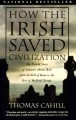 Includes bibliographical references and index.A look at how the Irish monasteries preserved all of the classical manuscripts that are now available while the rest of Europe was destroying them.
- Subjects: Learning and scholarship; Civilization, Classical; Books; Manuscripts; Monastic libraries; Transmission of texts.; Scriptoria;
- © 1995., Doubleday,
- Available copies: 1 / Total copies: 1
-
unAPI
- The ballad of Lord Edward and Citizen Small / by Jordan, Neil,1950-author.;
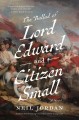 Includes bibliographical references."The tale is related by Tony Small, a runaway slave who becomes Lord Edward Fitzgerald's manservant and friend. While details of Lord Edward's life are well documented, little is known of Tony Small who rescued Fitzgerald after the Battle of Eutaw Springs during America's War of Independence and returned with him to Europe. In this gripping narrative his character considers the ironies of empire, captivity and freedom, mapping Lord Edward's journey from being a loyal subject of the British Empire to becoming a 1798 rebellion leader. The story embraces a rich cast of characters as action weaves from the Carolinas to London and Dublin, from the ferment of Paine and Robespierre's revolutionary Paris to Tournai and Hamburg, returning to Ireland for its tragic, inevitable denouement."--Provided by publisher.
- Subjects: Historical fiction.; Novels.; Fitzgerald, Edward, Lord, 1763-1798; Aristocracy (Social class); Fugitive slaves; Household employees; Male friendship;
- Available copies: 1 / Total copies: 1
-
unAPI
- We don't know ourselves : a personal history of modern Ireland / by O'Toole, Fintan,1958-author.;
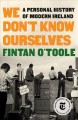 Includes bibliographical references and index."A celebrated Irish writer's magisterial, brilliantly insightful chronicle of the wrenching transformations that dragged his homeland into the modern world. Fintan O'Toole was born in the year the revolution began. It was 1958, and the Irish government?in despair, because all the young people were leaving?opened the country to foreign investment and popular culture. So began a decades-long, ongoing experiment with Irish national identity. In We Don't Know Ourselves, O'Toole, one of the Anglophone world's most consummate stylists, weaves his own experiences into Irish social, cultural, and economic change, showing how Ireland, in just one lifetime, has gone from a reactionary "backwater" to an almost totally open society-perhaps the most astonishing national transformation in modern history. Born to a working-class family in the Dublin suburbs, O'Toole served as an altar boy and attended a Christian Brothers school, much as his forebears did. He was enthralled by American Westerns suddenly appearing on Irish television, which were not that far from his own experience, given that Ireland's main export was beef and it was still not unknown for herds of cattle to clatter down Dublin's streets. Yet the Westerns were a sign of what was to come. O'Toole narrates the once unthinkable collapse of the all-powerful Catholic Church, brought down by scandal and by the activism of ordinary Irish, women in particular. He relates the horrific violence of the Troubles in Northern Ireland, which led most Irish to reject violent nationalism. In O'Toole's telling, America became a lodestar, from John F. Kennedy's 1963 visit, when the soon-to-be martyred American president was welcomed as a native son, to the emergence of the Irish technology sector in the late 1990s, driven by American corporations, which set Ireland on the path toward particular disaster during the 2008 financial crisis. A remarkably compassionate yet exacting observer, O'Toole in coruscating prose captures the peculiar Irish habit of "deliberate unknowing," which allowed myths of national greatness to persist even as the foundations were crumbling. Forty years in the making, We Don't Know Ourselves is a landmark work, a memoir and a national history that ultimately reveals how the two modes are entwined for all of us"--
- Subjects: Biographies.; Personal narratives.; O'Toole, Fintan, 1958-;
- Available copies: 1 / Total copies: 1
-
unAPI
- An Accidental Villain A Soldier's Tale of War, Deceit and Exile [electronic resource] : by MacIntyre, Linden.aut; CloudLibrary;
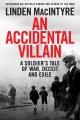 From the bestselling, prize-winning author Linden MacIntyre comes an engrossing, page-turning exploration of the little-known life of Sir Hugh Tudor. Appointed by his friend Winston Churchill to lead the police in Ireland during the Irish War of Independence, Tudor met civil strife and domestic terrorism with indiscriminate state-sanctioned murder—changing the course of Irish history. After distinguishing himself on the battlefields of the First World War, Major-General Sir Hugh Tudor could have sought a respectable retirement in England, his duty done. But in 1920, his old friend Winston Churchill, Minister of War in Lloyd George’s cabinet, called on Tudor to serve in a very different kind of conflict—one fought in the Irish streets and countryside against an enemy determined to resist British colonial authority to the death. And soon Tudor was directing a police force waging a brutal campaign against rebel “terrorists,” one he was determined to win at all costs—including utilizing police death squads and inflicting brutal reprisals against IRA members and supporters and Sinn Féin politicians. Tudor left few traces of his time in Ireland. No diary or letters that might explain his record as commander of the notorious Black and Tans. Nothing to justify his role in Bloody Sunday, November 21, 1920, when his men infamously slaughtered Irish football fans. And why did a man knighted for his efforts in Ireland leave his family and homeland in 1925, moving across the sea to Newfoundland? Linden MacIntyre has spent four years tracking Tudor through archives, contemporaries’ diaries and letters, and the body count of that Irish war. In An Accidental Villain, he delivers a consequential and fascinating account of how events can bring a man to the point where he acts against his own training, principles and inclination in the service of a cause—and ends up on a long journey toward personal oblivion.
- Subjects: Electronic books.; Ireland; Post-Confederation (1867-);
- © 2025., Random House of Canada,
-
unAPI
Results 1 to 6 of 6