Results 131 to 140 of 161 | « previous | next »
- Close to the Bone. by Thomas, Jared,film director.; McKinnon, Malcolm,film director.; Ronin Films (Firm),dst; Kanopy (Firm),dst;
 Originally produced by Ronin Films in 2022.In September 1852, in South Australia’s Flinders Ranges, the mutilated body of 16-year-old shepherd, James Brown, was found. The next day, a reprisal party of 17 men killed a disputed number of First Nations people. 170 years later, descendants of James Brown’s family return to the Flinders Ranges and reach out to people from some of the Aboriginal groups and share memories of the traumatic early period of European invasion. What happens when stories of violence and conquest on Australia’s colonial frontier are more than just an historical abstraction, with powerful and personal meanings for families and individuals on both sides of the inter-cultural frontier? Can the scars of past atrocities be reconciled and healed through the act of truth-telling? CLOSE TO THE BONE is a practical exercise in ‘truth and reconciliation,’ engaging with culturally and politically challenging material, in an effort to forge shared understandings. The film reveals diverse understandings of historic events, while seeking to resolve a shared path forward. In doing so, the film is informed by Charlie Perkins’ words: ‘We know we cannot live in the past, but the past lives in us.’Mode of access: World Wide Web.
- Subjects: Documentary films.; Social sciences.; Australians.; Foreign study.; History, Modern.; Documentary films.; Indigenous peoples.; Current affairs.; History.; Violence.; Aboriginal Australians.; Australia.;
-
unAPI
- Close to the Bone. by Thomas, Jared,film director.; McKinnon, Malcolm,film director.; Ronin Films (Firm),dst; Kanopy (Firm),dst;
 Originally produced by Ronin Films in 2022.In September 1852, in South Australia’s Flinders Ranges, the mutilated body of 16-year-old shepherd, James Brown, was found. The next day, a reprisal party of 17 men killed a disputed number of First Nations people. 170 years later, descendants of James Brown’s family return to the Flinders Ranges and reach out to people from some of the Aboriginal groups and share memories of the traumatic early period of European invasion. What happens when stories of violence and conquest on Australia’s colonial frontier are more than just an historical abstraction, with powerful and personal meanings for families and individuals on both sides of the inter-cultural frontier? Can the scars of past atrocities be reconciled and healed through the act of truth-telling? CLOSE TO THE BONE is a practical exercise in ‘truth and reconciliation,’ engaging with culturally and politically challenging material, in an effort to forge shared understandings. The film reveals diverse understandings of historic events, while seeking to resolve a shared path forward. In doing so, the film is informed by Charlie Perkins’ words: ‘We know we cannot live in the past, but the past lives in us.’Mode of access: World Wide Web.
- Subjects: Documentary films.; Social sciences.; Australians.; Foreign study.; History, Modern.; Documentary films.; Indigenous peoples.; Current affairs.; History.; Violence.; Aboriginal Australians.; Australia.;
-
unAPI
- Rivers of power : how a natural force raised kingdoms, destroyed civilizations, and shapes our world / by Smith, Laurence C.,author.;
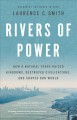 Includes bibliographical references and index.From a renowned geographer and professor of earth, planetary and space sciences, a sweeping natural history of rivers and their complex and ancient relationship with human civilization. Rivers, more than any road, technology, or political leader, have shaped the course of civilization. They have opened frontiers, founded cities, settled borders, and fed billions. They promote life, forge peace, grant power, and capriciously destroy everything in their path. And even as they have become increasingly domesticated, rivers remain a powerful global force, one that is more critical than ever to our future. In Rivers of Power, geographer Laurence Smith takes a deep dive into the timeless and vastly underappreciated relationship between rivers and civilization as we know it. Rivers are of course important to us in all the obvious ways (like water supply, sanitation, transport, etc.). But they also shape us in less obvious ways. Massive amounts of river water support the global food trade; huge volumes are consumed to provide the world's electricity -- not just by hydropower, but by coal, nuclear, and natural gas power plants too; most of our globally important cities are positioned on the banks of rivers or river deltas. The territories of nations, their cultural and economic ties to one another, and the migrations of people trace to rivers and the topographic divides they carve on the world. Beautifully told and expansive in scope, Rivers of Power, reveals how and why rivers have so profoundly shaped civilization, and examines the importance this vast, arterial power holds for our present, past, and future.
- Subjects: Rivers.; Rivers; Water and civilization.; Science.;
- Available copies: 1 / Total copies: 1
-
unAPI
- In Putin's footsteps : searching for the soul of an empire across Russia's eleven time zones / by Khrushcheva, Nina L.,1962-author.; Tayler, Jeffrey,author.;
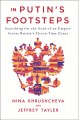 Includes bibliographical references and index."In Putin's Footsteps is Nina Khrushcheva and Jeffrey Tayler's unique combination of travelogue, current affairs, and history, showing how Russia's dimensions have shaped its identity and culture through the decades. With exclusive insider status as Nikita Khrushchev's great grand-daughter, and an ex-pat living and reporting on Russia and the Soviet Union since 1983, Nina Khrushcheva and Jeffrey Tayler offer a poignant exploration of the largest country on earth through their recreation of Vladimir Putin's fabled New Year's Eve speech planned across all eleven time zones. After taking over from Yeltsin in 1999, and then being elected president in a landslide, Putin traveled to almost two dozen countries and a quarter of Russia's eighty-nine regions to connect with ordinary Russians. His travels inspired the idea of a rousing New Year's Eve address delivered every hour at midnight throughout Russia's eleven time zones. The idea was beautiful, but quickly abandoned as an impossible feat. He correctly intuited, however, that the success of his presidency would rest on how the country's outback citizens viewed their place on the world stage. Today more than ever, Putin is even more determined to present Russia as a formidable nation. We need to understand why Russia has for centuries been an adversary of the West. Its size, nuclear arsenal, arms industry, and scientific community (including cyber-experts), guarantees its influence"--
- Subjects: Khrushcheva, Nina L., 1962-; Tayler, Jeffrey; Putin, Vladimir Vladimirovich, 1952-; Regionalism;
- Available copies: 1 / Total copies: 1
-
unAPI
- One way back : a memoir / by Blasey, Christine,author.;
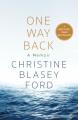 "On September 27, 2018, Christine Blasey Ford testified before the Senate Judiciary Committee which was considering the nomination of Judge Brett Kavanaugh to the United States Supreme Court. She described an alleged sexual assault by the Supreme Court nominee that took place at a high school party in the 1980s. Her words and courage on that day provided some of the most credible and unforgettable testimony our country has ever witnessed. In One Way Back, Ford recounts the months she spent trying to get information into the right hands without exposing herself and her family to dangerous backlash. Drawing parallels to her life as a surfer, she explains the process of paddling out into unknown waters despite the risks and fears, knowing there is only one way back to shore. The book reveals riveting new details about the leadup to her testimony and its overwhelming aftermath and describes how she continues to navigate her way out of the storm. This is the real story behind the headlines and the soundbites, a complex, page-turning memoir of a scientist, a surfer, a mother, a patriot and an unlikely whistleblower. Ford's experience shows that when one person steps forward to speak truth to power, she adds to a collective whole, causing 'a ripple that might one day become a wave.'"--
- Subjects: Biographies.; Personal narratives.; Blasey, Christine.; Kavanaugh, Brett, 1965-; United States. Congress. Senate. Committee on the Judiciary.; United States. Supreme Court; Judges; Sexual abuse victims; Sexual assault;
- Available copies: 1 / Total copies: 1
-
unAPI
- Commanding hope : the power we have to renew a world in peril / by Homer-Dixon, Thomas F.,author.;
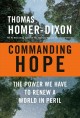 "Calling on history, cutting-edge research, complexity science and even Lord of the Rings, Homer-Dixon lays out the tools we can command to rescue a world on the brink. For three decades, the renowned author of The Upside of Down: Catastrophe, Creativity, and the Renewal of Civilization, and The Ingenuity Gap: Can We Solve the Problems of the Future?, has examined the threats to our future security--predicting a deteriorating global environment, extreme economic stresses, mass migrations, social instability and wide political violence if humankind continued on its current course. He was called The Doom Meister, but we now see how prescient he was. Today just about everything we've known and relied on (our natural environment, economy, societies, cultures and institutions) is changing dramatically--too often for the worse. Without radical new approaches, our planet will become unrecognizable as well as poorer, more violent, more authoritarian. In his fascinating long-awaited new book (dedicated to his young children), he calls on his extraordinary knowledge of complexity science, of how societies work and can evolve, and of our capacity to handle threats, to show that we can shift human civilization onto a decisively new path if we mobilize our minds, spirits, imaginations and collective values. Commanding Hope marshals a fascinating, accessible argument for reinvigorating our cognitive strengths and belief systems to affect urgent systemic change, strengthen our economies and cultures, and renew our hope in a positive future for everyone on Earth."-- Provided by publisher.
- Subjects: Creative ability.; Environmental responsibility.; Social change.;
- Available copies: 1 / Total copies: 1
-
unAPI
- Breakdown in Maine. by Berry, Bronwyn,film director.; PBS (Firm),dst; Kanopy (Firm),dst;
 Originally produced by PBS in 2024.Investigating the deadliest mass shooting in Maine history and missed opportunities to prevent it. With the Portland Press Herald and Maine Public, examining breakdowns with police, military and mental health care before the Lewiston shooting. From FRONTLINE.Mode of access: World Wide Web.
- Subjects: Documentary films.; Criminal law.; Social sciences.; Americans.; Foreign study.; Sociology.; Documentary films.; Current affairs.; United States--Politics and government.; Mass shootings.; Firearms.; True crime stories.;
-
unAPI
- Go-Go City. by George, Samuel,film director.; Bertelsmann Foundation Documentary Films (Firm),dst; Kanopy (Firm),dst;
 Originally produced by Bertelsmann Foundation Documentary Films in 2021.For decades, Washington DC has stood as a beacon for Black culture and community. Yet a breakneck wave of gentrification threatens to erase this history. GO-GO CITY dives into this rich tapestry, as well as the forces of gentrification that stand to mute it. The film interweaves scenes of massive 2020 protests against racial inequality that filled the neighborhoods of the nation’s capital. Follow along as displaced communities rally around the city’s beloved Go-Go music to retake the streets.Mode of access: World Wide Web.
- Subjects: Documentary films.; Enthnology.; Social sciences.; Human rights.; Sociology.; Documentary films.; Ethnicity.; Current affairs.; African Americans.; Political participation.; Communities.; Gentrification.;
-
unAPI
- The China study : the most comprehensive study of nutrition ever conducted and the startling implications for diet, weight loss and long-term health / by Campbell, T. Colin,1934-author.; Campbell, Thomas M.,II,author.;
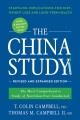 Includes bibliographical references (pages 389-438) and index.This work presents the results of a large study of diet and death rates from cancer in adults across China and Taiwan and explains the study's significance and what it reveals about the implications of poor nutrition. While revealing that proper nutrition can have a dramatic effect on reducing and reversing these ailments as well as obesity, this text calls into question the practices of many of the current dietary programs, such as the Atkins diet, that enjoy widespread popularity in the West. The impact of the politics of nutrition and the efforts of special interest groups on the creation and dissemination of public information on nutrition are also discussed.
- Subjects: Diet in disease.; Food Habits.; Health.; Nutrition.; Nutritionally induced diseases.; Self-care, Health.; Vegetarianism.;
- Available copies: 1 / Total copies: 1
-
unAPI
- The great wave : the era of radical disruption and the rise of the outsider / by Kakutani, Michiko,author.;
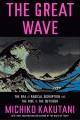 Includes bibliographical references."An urgent examination of how disruptive politics, technology, and art are capsizing old assumptions in a great wave of change breaking over today's world, creating both opportunity and peril-from the Pulitzer Prize-winning critic and author of the New York Times bestseller The Death of Truth. The twenty-first century is experiencing a watershed moment defined by chaos and uncertainty, as one emergency cascades into another, underscoring the larger dynamics of change that are fueling instability across the world. Since the global financial crisis of 2008, people have increasingly lost trust in institutions and elites, while seizing upon new digital tools to sidestep traditional gatekeepers. As a result, powerful new voices-once regarded as radical, unorthodox or marginal-are disrupting the status quo in politics, business and culture. Meanwhile, social and economic inequalities are stoking populist rage across the world, toxic partisanship is undermining democratic ideals, and the internet and AI have become high-speed vectors for the spread of misinformation. Writing with a critic's understanding of cultural trends and a journalist's eye for historical detail, Michiko Kakutani looks at the consequences of these new asymmetries of power. She maps the migration of ideas from the margins to the mainstream and explores the growing influence of outsiders-those who have sown anger and fear (like Donald Trump), and those who have provided inspirational leadership (like Ukraine's president Volodymyr Zelensky). At the same time, she situates today's multiplying crises in context with those that defined earlier hinge moments in history, from the waning of the Middle Ages, to the transition between the Gilded Age and Progressive era at the end of the nineteenth century. Kakutani argues that today's crises are not only signs of an interconnected globe's profound vulnerabilities, but stress tests pointing to the essential changes needed to survive this tumultuous era and build a more sustainable future"--
- Subjects: Civilization, Modern; Elite (Social sciences); Globalization.; Political culture.; Power (Social sciences); Uncertainty.;
- Available copies: 1 / Total copies: 1
-
unAPI
Results 131 to 140 of 161 | « previous | next »