Results 141 to 150 of 587 | « previous | next »
- Streampunks : YouTube and the rebels remaking media / by Kyncl, Robert,author.; Peyvan, Maany,author.;
 "An entertainment and tech insider--YouTube's chief business officer--delivers the first detailed account of the rise of YouTube, the creative minds who have capitalized on it to become pop culture stars, and how streaming video is revolutionizing the media world. In the past ten years, the internet video platform YouTube has changed media and entertainment as profoundly as the invention of film, radio, and television did, more than six decades earlier. Streampunks is a firsthand account of this upstart company, examining how it evolved and where it will take us next. Sharing behind-the-scenes stories of YouTube's most influential stars--Streampunks like Tyler Oakley, Lilly Singh, and Casey Neistat--and the dealmakers brokering the future of entertainment like Scooter Braun and Shane Smith, Robert Kyncl uses his experiences at three of the most innovative media companies, HBO, Netflix, and YouTube, to tell the story of streaming video and this modern pop culture juggernaut. Collaborating with Google speechwriter Maany Peyvan, Kyncl explains how the new rules of entertainment are being written and how and why the media landscape is radically changing, while giving aspiring Streampunks some necessary advice to launch their own new media careers. Kyncl persuasively argues that, despite concerns about technology impoverishing artists or undermining artistic quality, the new media revolution is actually fueling a creative boom and leading to more compelling, diverse, and immersive content. Enlightening, surprising, and thoroughly entertaining, Streampunks is a revelatory ride through the new media rebellion that is reshaping our world"--
- Subjects: YouTube (Electronic resource); Digital media; Internet entertainment.; Internet videos; Mass media.; Streaming technology (Telecommunications); Webcasting.;
- Available copies: 1 / Total copies: 1
-
unAPI
- The Social Trap. by Jadot, Elisa,film director.; Java Films (Firm),dst; Kanopy (Firm),dst;
 Originally produced by Java Films in 2024.Adolescents who are connected to their smartphone for more than five hours a day are 66% more likely to suffer suicidal symptoms than those who use it for one hour a day. 44 US states are currently suing Meta, blaming it for the malaise of an entire generation. Faced with powerful tech giants like Meta, Tiktok, Snapchat, X and Discord, how can we protect children and their childhood?For the first time in history, state legislators and parents in the US and Europe are joining forces to fight these digital giants. Among them are five women who have chosen to turn their daily lives upside down to fight back against the Big 5: Alexis, Elisabet, Sofia, Laure and Socheata.They are victims, mothers, doctors and lawyers. They’re all behind a movement to change the destiny of future generations. Alexis, a victim of screen addiction, was among the first to take Meta to court, accusing it of “inciting suicide.” Elisabet is a mother of three. In just a few days, over 10,000 parents joined her WhatsApp group to fight for a "phone-free youth." As a result, the state has banned smartphones in schools. Sofia is a psychiatrist and pioneer in the treatment of screen addiction in children, some as young as seven. Socheata has been involved in the fight ever since her son was manipulated by an internet predator. She has joined an organisation that works alongside cybercrime police officers to track down paedophiles. Laure is a lawyer determined to change the laws that protect the Big 5.Through the struggles of these women, we will discover that digital control is a major public health and safety issue that goes well beyond what we imagine.Mode of access: World Wide Web.
- Subjects: Documentary films.; Mass media.; Digital communications.; Health.; Criminal law.; Social sciences.; Science.; Child welfare.; Computer science.; Documentary films.; Mass media and culture.; Women's studies.; Current affairs.; Substance abuse.; Motion pictures--France.; Social media.; Youth.; Women social reformers.; Child psychology.; Self-esteem.; Motion pictures--Europe.;
-
unAPI
- Generation Flex. by Newton, Dorenna,film director.; Collective Eye Films (Firm),dst; Kanopy (Firm),dst;
 Originally produced by Collective Eye Films in 2024.THERE'S SOMETHING BIG going on with boys.Maybe you've seen an influx of teenagers at your local gym. Maybe you've noticed more kids carrying around blender bottles. Maybe you've even witnessed the social media phenomenon that is a teenage fitness influencer. What's big with boys right now is getting huge. Jacked arms. Swole chests. Chiseled abs. Spurred by intense pressure and unattainable body standards, boys are risking their physical and mental health to build muscle and lose weight. We know this because for the last year Men's Health followed the stories of four young teens in their quests to bulk up and get cut. What we found was a dark world of social media manipulation, shady supplements, and very real consequences. And we talked to the top experts in the country—from behavioral health researchers to emergency clinicians—for their insights and advice. Whether you're a parent, caregiver, coach, or kid (and, actually, especially if you're a kid), GENERATION FLEX is a warning shot to the dangers of excessive exercise, fit-fluencer culture, and supplement overuse.Mode of access: World Wide Web.
- Subjects: Documentary films.; Social sciences.; Psychology.; Physical education and training.; Health.; Gender identity.; Mental health.; Documentary films.; Mass media and culture.; Social media.; Mass media and gender.; Men's studies.; Exercise.; Masculinity.; Child psychology.; Youth--Social life and customs.;
-
unAPI
- Idol, burning : a novel / by Usami, Rin,1999-author.; Yoneda, Asa,translator.; translation of:Usami, Rin,1999-Oshi, moyu.English.;
 "Akari is a high school junior obsessed with "oshi" Masaki Ueno, a member of the popular J-Pop group Maza Maza. She writes a blog devoted to him, and spends hours addictively scrolling for information about him and his life. Desperate to analyze and understand him, Akari hopes to eventually see the world through his eyes. It is a devotion that borders on the religious: Masaki is her savior, her backbone, someone she believes she cannot survive without-even though she's never actually met him. When rumors surface that her idol assaulted a female fan, social media explodes. Akari immediately begins sifting through everything she can find about the scandal, and shares every detail to her blog-including Masaki's denials and pleas to his fans-drawing numerous readers eager for her updates. But the organized, knowledgeable persona Akari presents online is totally different from the socially awkward, unfocused teenager she is in real life. As Masaki's situation spirals, his troubles threaten to tear apart her life too. Instead of finding a way to break free to save herself, Akari becomes even more fanatical about Masaki, still believing her idol is the only person who understands her"--
- Subjects: Psychological fiction.; Novels.; Bloggers; Fans (Persons); High school students; Musicians; Parasocial relationships; Popular music; Rumor; Scandals; Social media;
- Available copies: 1 / Total copies: 1
-
unAPI
- Somebody told me ... : one man's unexpected journey down the rabbit hole of lies, trolls, and conspiracies / by Wallace, Danny,author.;
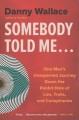 "Bestselling author Danny Wallace (Yes Man and Join Me) takes on the modern epidemic of lies, conspiracy theories, and disinformation to find out if truth has a chance in the fight. Have your loved ones been pulled into the rabbit hole of online conspiracies? Are they spouting strange theories about secret cabals or admiring authoritarian leaders? How did we become so vulnerable to false beliefs? Wallace's eye-opening investigation explores the ripple effects of misinformation -- meeting families torn apart, journalists on the frontlines, reformed conspiracy believers, influencers cashing in on fear, and the faceless trolls spreading lies. He reveals how disinformation not only devastates lives but divides communities and reshapes nations. False narratives seize our imaginations, leaving us feeling both powerless and oddly energized. With trademark wit and keen insight, Wallace delivers a timely, thought-provoking exploration that will make you question everything you think you know about truth in the digital age"--
- Subjects: Conspiracy theories.; Deception.; Disinformation.; Fake news.; Internet; Mass media; Misinformation.; Online manipulation.; Truthfulness and falsehood.;
- Available copies: 1 / Total copies: 1
-
unAPI
- The anxious generation : how the great rewiring of childhood is causing an epidemic of mental illness / by Haidt, Jonathan,author.;
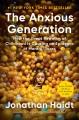 Includes bibliographical references and index."From New York Times bestselling coauthor of The Coddling of the American Mind, an essential investigation into the collapse of youth mental health-and a plan for a healthier, freer childhood. After more than a decade of stability or improvement, the mental health of adolescents plunged in the early 2010s. Rates of depression, anxiety, self-harm, and suicide rose sharply, more than doubling on most measures. Why? In The Anxious Generation, social psychologist Jonathan Haidt lays out the facts about the epidemic of teen mental illness that hit many countries at the same time. He then investigates the nature of childhood, including why children need play and independent exploration to mature into competent, thriving adults. Haidt shows how the "play-based childhood" began to decline in the 1980s, and how it was finally wiped out by the arrival of the "phone-based childhood" in the early 2010s. He presents more than a dozen mechanisms by which this "great rewiring of childhood" has interfered with children's social and neurological development, covering everything from sleep deprivation to attention fragmentation, addiction, loneliness, social contagion, social comparison, and perfectionism. He explains why social media damages girls more than boys and why boys have been withdrawing from the real world into the virtual world, with disastrous consequences for themselves, their families, and their societies. Most important, Haidt issues a clear call to action. He diagnoses the "collective action problems" that trap us, and then proposes four simple rules that might set us free. He describes steps that parents, teachers, schools, tech companies, and governments can take to end the epidemic of mental illness and restore a more humane childhood. Haidt has spent his career speaking truth backed by data in the most difficult landscapes-communities polarized by politics and religion, campuses battling culture wars, and now the public health emergency faced by Gen Z. We cannot afford to ignore his findings about protecting our children-and ourselves-from the psychological damage of a phone-based life"--
- Subjects: Child development; Child mental health; Children; Internet and children; Social media;
- Available copies: 0 / Total copies: 2
-
unAPI
- The anxious generation [sound recording] : how the great rewiring of childhood is causing an epidemic of mental illness / by Haidt, Jonathan,author,narrator.; Pratt, Sean,narrator.; Blackstone Publishing,publisher.;
 Read by Sean Pratt, Jonathan Haidt."From New York Times bestselling coauthor of The Coddling of the American Mind, an essential investigation into the collapse of youth mental health-and a plan for a healthier, freer childhood. After more than a decade of stability or improvement, the mental health of adolescents plunged in the early 2010s. Rates of depression, anxiety, self-harm, and suicide rose sharply, more than doubling on most measures. Why? In The Anxious Generation, social psychologist Jonathan Haidt lays out the facts about the epidemic of teen mental illness that hit many countries at the same time. He then investigates the nature of childhood, including why children need play and independent exploration to mature into competent, thriving adults. Haidt shows how the "play-based childhood" began to decline in the 1980s, and how it was finally wiped out by the arrival of the "phone-based childhood" in the early 2010s. He presents more than a dozen mechanisms by which this "great rewiring of childhood" has interfered with children's social and neurological development, covering everything from sleep deprivation to attention fragmentation, addiction, loneliness, social contagion, social comparison, and perfectionism. He explains why social media damages girls more than boys and why boys have been withdrawing from the real world into the virtual world, with disastrous consequences for themselves, their families, and their societies. Most important, Haidt issues a clear call to action. He diagnoses the "collective action problems" that trap us, and then proposes four simple rules that might set us free. He describes steps that parents, teachers, schools, tech companies, and governments can take to end the epidemic of mental illness and restore a more humane childhood. Haidt has spent his career speaking truth backed by data in the most difficult landscapes-communities polarized by politics and religion, campuses battling culture wars, and now the public health emergency faced by Gen Z. We cannot afford to ignore his findings about protecting our children-and ourselves-from the psychological damage of a phone-based life"--
- Subjects: Audiobooks.; Child development; Child mental health; Children; Internet and children; Social media;
- Available copies: 1 / Total copies: 1
-
unAPI
- Too famous : the rich, the powerful, the wishful, the notorious, the damned / by Wolff, Michael,1953-author.; Wolff, Michael,1953-Columns.Selections.;
 "The bestselling author of Fire and Fury is once again coming for some of the largest power brokers in America as he brings to light their lives, careers, and always equivocal end games"--
- Subjects: Biographies.; Celebrities in mass media.; Executives; Fame.; Gossip in mass media.; Journalists; Mass media; Politicians; Publishers and publishing; Television broadcasting of news;
- Available copies: 1 / Total copies: 1
-
unAPI
- Panorama: Can We Live Without Our Phones?. by McAuley, Joseph,film director.; BBC Studios (Firm),dst; Kanopy (Firm),dst;
 Originally produced by BBC Studios in 2024.What happens when smartphones are taken away from kids for a week? With the help of two families and lots of remote cameras, Panorama finds out. Do they talk to their parents more, sleep better, or miss out on vital conversations with friends and the chance to discover something new? With calls for smartphones to be banned for children, Marianna Spring speaks to parents, teenagers and social media company insiders to investigate whether the content pushed to their feeds is harming them.Mode of access: World Wide Web.
- Subjects: Documentary films.; Health.; Science.; Social sciences.; Psychology.; Child welfare.; Computer science.; Mental health.; Documentary films.; Substance abuse.; Children.; Cell phones.; Social media.; Youth.; Child development.; Child psychology.; Internet.; Parents.;
-
unAPI
- Uncle : race, nostalgia, and the politics of loyalty / by Thompson, Cheryl,1977-author.;
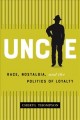 Includes bibliographical references and index."Jackie Robinson, President Barack Obama, Supreme Court Justice Clarence Thomas, O. J. Simpson, and Christopher Darden have all been accused of being an Uncle Tom during their careers. How, why, and with what consequences for our society did Uncle Tom morph first into a servile old man and then into a racial epithet hurled at African American men deemed, by other Black people, to have betrayed their race? Uncle Tom, the eponymous figure in Harriet Beecher Stowe's sentimental anti-slavery novel, Uncle Tom's Cabin, was a loyal Christian who died a martyr's death. But soon after the best-selling novel appeared, theatre troupes across North America and Europe transformed Stowe's story into minstrel shows featuring white men in blackface. In Uncle, Cheryl Thompson traces Tom's journey from literary character to racial trope. She exposes the relentless reworking of Uncle Tom into a nostalgic, racial metaphor with the power to shape how we see Black men, a distortion visible in everything from Uncle Ben and Rastus the Cream of Wheat chef to the first interracial dance partners in Hollywood, Shirley Temple and Bill ‘Bojangles' Robinson. In a post-truth North America, where nostalgia is used as a political tool to rewrite history, Uncle makes the case for why understanding the production of racial stereotypes matters more than ever before."-- Provided by publisher.
- Subjects: Stowe, Harriet Beecher, 1811-1896.; Uncle Tom (Fictitious character); African Americans in mass media.; African Americans in popular culture.; African Americans; Stereotypes (Social psychology);
- Available copies: 1 / Total copies: 1
-
unAPI
Results 141 to 150 of 587 | « previous | next »