Results 201 to 210 of 272 | « previous | next »
- So help me golf : why we love the game / by Reilly, Rick,author.;
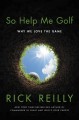 "Beloved bestselling author and golf aficionado Rick Reilly channels his insatiable curiosity, trademark sense of humor, and vast knowledge of the game in a treasure trove of original pieces about what the game has meant to him and to others. This is the book Rick Reilly has been writing in the back of his head since he fell in love with the game of golf at eleven years old. He unpacks and explores all of the wonderful, maddening, heart-melting, heart-breaking, cool, and captivating things about golf that make the game so utterly addictive. We meet the PGA Tour player who robbed banks by night to pay his motel bills, the golf club maker who takes weekly psychedelic trips, and the caddy who kept his loop even after an 11-year prison stint. We learn how a man on his third heart nearly won the U.S. Open, how a Vietnam POW saved his life playing 18 holes a day in his tiny cell, and about the course that's absolutely free. Reilly mines all of the game's quirky traditions-from the shot of bourbon you take before you tee off at Peyton Manning's course, to the way the starter at St. Andrews announces to your group (and the hundreds of tourists watching), "You're on the first tee, gentlemen." He means that quite literally: St. Andrews has the first tee ever invented. We'll visit the eighteen most unforgettable holes around the world (Reilly has played them all), including the hole in Indonesia where the biggest hazard is monkeys, the one in the Caribbean that's underwater, and the one in South Africa that requires a shot over a pit of alligators; not to mention Reilly's attempt to play the most mini-golf holes in one day. Reilly expounds on all the great figures in the game, from Phil Mickelson to Bobby Jones to the simple reason Jack Nicklaus is better than Tiger Woods. He explains why we should stop hating Bryson DeChambeau unless we hate genius, the greatest upset in women's golf history, and why Ernie Els throws away every ball that makes a birdie. Plus all the Greg Norman stories Reilly has never been able to tell before, and the great fun of being Jim Nantz. Connecting it all will be the story of Reilly's own personal journey through the game, especially as it connects to his tumultuous relationship with his father, and how the two eventually reconciled through golf. This is Reilly's valentine to golf, a cornucopia of stories that no golfer will want to be without"--
- Subjects: Anecdotes.; Golf;
- Available copies: 1 / Total copies: 1
-
unAPI
- Atlas of cats / by Evans, Frances(Children's author); Heaton, Kelsey.;
 Get your fill of feline facts in this definitive guide to cats from around the world with amazing illustrations and claw-some profiles and features! Large continent maps show the origin of 100 fascinating breeds including the fluff-tastic ragamuffin and hairless sphynx, plus get the lowdown on each cat's unique skills and find fact-packed spreads about cats in ancient Egypt, courageous cats, cute kittens, and more. Inside Atlas of Cats : 100 awesome breeds and crossbreeds of domestic and wild cats from North and South America; Europe; Africa; Western and Northern Asia; Southern, Southeast and East Asia and Australasia -- Large maps of each continent show where each cat originates from -- Atlas of a cat's body provides readers with basic cat geography from their coat to their claws -- Learn about a cat's amazing super senses plus discover how to speak cat -- Fun-packed profiles give details on each cat's personality traits, unique skills, and incredible adaptations -- Special themed features cover courageous cats, cat shows, cute kittens, cats in ancient Egypt, oriental cats, natural instincts, wild cats, cat culture, record-breaking cats. From the creative duo behind Lonely Planet's bestselling Atlas of Dogs : once again written by Frances Evans and featuring lively, light hearted illustrations by Kelsey Heaton Jam-packed with plenty of cat-titude, this is the purr-fect book for curious kids who want to learn more about one of the world's most beloved pets.
- Subjects: Children's atlases.; Illustrated works.; Cats; Cat breeds;
- Available copies: 1 / Total copies: 1
-
unAPI
- Unrequited infatuations : odyssey of a rock and roll consigliere : (a cautionary tale) / by Van Zandt, Steve,author.; Greenman, Ben,editor.;
 Uncover never-before-told stories in this epic tale of self-discovery by a Rock n Roll disciple and member of the E Street Band. What story begins in a bedroom in suburban New Jersey in the early '60s, unfolds on some of the country's largest stages, and then ranges across the globe, demonstrating over and over again how Rock and Roll has the power to change the world for the better? This story. The first true heartbeat of Unrequited Infatuations is the moment when Stevie Van Zandt trades in his devotion to the Baptist religion for an obsession with Rock and Roll. Groups like the Beatles and the Rolling Stones created new ideas of community, creative risk, and principled rebellion. They changed him forever. While still a teenager, he met Bruce Springsteen, a like-minded outcast/true believer who became one of his most important friends and bandmates. As Miami Steve, Van Zandt anchored the E Street Band as they conquered the Rock and Roll world. And then, in the early '80s, Van Zandt stepped away from E Street to embark on his own odyssey. He refashioned himself as Little Steven, a political songwriter and performer, fell in love with Maureen Santoro who greatly expanded his artistic palette, and visited the world's hot spots as an artist/journalist to not just better understand them, but to help change them. Most famously, he masterminded the recording of "Sun City," an anti-apartheid anthem that sped the demise of South Africa's institutionalized racism and helped get Nelson Mandela out of prison. By the '90s, Van Zandt had lived at least two lives--one as a mainstream rocker, one as a hardcore activist. It was time for a third. David Chase invited Van Zandt to be a part of his new television show, the Sopranos--as Silvio Dante, he was the unconditionally loyal consiglieri who sat at the right hand of Tony Soprano (a relationship that oddly mirrored his real-life relationship with Bruce Springsteen). Underlying all of Van Zandt's various incarnations was a devotion to preserving the centrality of the arts, especially the endangered species of Rock. In the twenty-first century, Van Zandt founded a groundbreaking radio show (Little Steven's Underground Garage), created the first two 24/7 branded music channels on SiriusXM (Underground Garage and Outlaw Country), started a fiercely independent record label (Wicked Cool), and developed a curriculum to teach students of all ages through the medium of music history. He also rejoined the E Street Band for what has now been a twenty-year victory lap. ​Unrequited Infatuations chronicles the twists and turns of Stevie Van Zandt's always surprising life. It is more than just the testimony of a globe-trotting nomad, more than the story of a groundbreaking activist, more than the odyssey of a spiritual seeker, and more than a master class in rock and roll (not to mention a dozen other crafts). It's the best book of its kind because it's the only book of its kind.
- Subjects: Biographies.; Autobiographies.; Van Zandt, Steve.; Rock musicians;
- Available copies: 1 / Total copies: 1
-
unAPI
- The duel : Diefenbaker, Pearson and the making of modern Canada / by Ibbitson, John,author.;
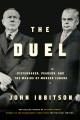 Includes bibliographical references and index."One of Canada's foremost authors and journalists offers a gripping account of the contest between John Diefenbaker and Lester Pearson, two prime ministers who fought each other relentlessly, but who between them created today's Canada. John Diefenbaker has been unfairly treated by history. Although he wrestled with personal demons, his governments launched major reforms in public health care, law reform and immigration. On his watch, First Nations on reserve obtained the right to vote and the federal government began to open up the North. He established Canada as a leader in the struggle against apartheid in South Africa, and took the first steps in making Canada a leader in the fight against nuclear proliferation. And Diefenbaker's Bill of Rights laid the groundwork for the Charter of Rights and Freedoms. He set in motion many of the achievements credited to his successor, Lester B. Pearson. Pearson, in turn, gave coherence to Diefenbaker's piecemeal reforms. He also pushed Parliament to adopt a new, and now much-loved, Canadian flag against Diefenbaker's fierce opposition. Pearson understood that if Canada were to be taken seriously as a nation, it must develop a stronger sense of self. Pearson was superbly prepared for the role of prime minister: decades of experience at External Affairs, respected by leaders from Washington to Delhi to Beijing, the only Canadian to win the Nobel Prize for Peace. Diefenbaker was the better politician, though. If Pearson walked with ease in the halls of power, Diefenbaker connected with the farmers and small-town merchants and others left outside the inner circles. Diefenbaker was one of the great orators of Canadian political life; Pearson spoke with a slight lisp. Diefenbaker was the first to get his name in the papers, as a crusading attorney: Diefenbaker for the Defence, champion of the little man. But he struggled as a politician, losing five elections before making it into the House of Commons, and becoming as estranged from the party elites as he was from the Liberals, until his ascension to the Progressive Conservative leadership in 1956 through a freakish political accident. As a young university professor, Pearson caught the attention of the powerful men who were shaping Canada's first true department of foreign affairs, rising to prominence as the helpful fixer, the man both sides trusted, the embodiment of a new country that had earned its place through war in the counsels of the great powers: ambassador, undersecretary, minister, peacemaker. Everyone knew he was destined to be prime minister. But in 1957, destiny took a detour. Then they faced each other, Diefenbaker v Pearson, across the House of Commons, leaders of their parties, each determined to wrest and hold power, in a decade-long contest that would shake and shape the country. Here is a tale of two men, children of Victoria, who led Canada into the atomic age: each the product of his past, each more like the other than either would ever admit, fighting each other relentlessly while together forging the Canada we live in today. To understand our times, we must first understand theirs"--
- Subjects: Biographies.; Personal narratives.; Diefenbaker, John G., 1895-1979.; Pearson, Lester B.; Prime ministers;
- Available copies: 1 / Total copies: 1
-
unAPI
- International Adoptions. by Tournadre, Christine,film director.; Gonzalez, Sonia,film director.; Java Films (Firm),dst; Kanopy (Firm),dst;
 Originally produced by Java Films in 2024.Over the past sixty years, over a million ‘orphans’ were adopted by Western families from around the world. Now many are discovering their past was a lie. From the children who were stolen from their mothers during the Pinochet dictatorship, to Africa’s fake orphans, international adoption is at the heart of an unprecedented scandal. We join investigative journalists, activists and researchers in South Korea, Sweden, France, Chile, Germany, Holland and Switzerland. How did this colossal, lucrative market manage to prosper? And why does it live on today?Mode of access: World Wide Web.
- Subjects: Documentary films.; Social sciences.; Human rights.; Documentary films.; Current affairs.; Organized crime.; Adoption.; Human trafficking.;
-
unAPI
- The power of women : a doctor's journey of hope and healing / by Mukwege, Denis,author.;
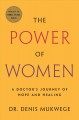 Includes bibliographical references and index."From Nobel laureate, world-renowned doctor, and noted human rights activist Dr. Denis Mukwege comes an inspiring clarion call-to-action to confront the scourge of sexual violence and better learn from women's resilience, strength, and power. At the heart of Dr. Mukwege's message will be the voices of the many women he has worked with over the years. Dr. Mukwege will use individual cases to reassure all survivors that, even if their psychological wounds may never fully heal, they can recover and thrive with the right care and support. Dr. Mukwege's dramatic personal story is interwoven throughout as he explores the bigger issues that have become a focus of his advocacy. He will seek to explain why sexual violence is so often overlooked during war, and how governments need to recognize and compensate victims. He will also stress the importance of breaking down the taboos surrounding assault, and the necessity of building a system that supports women who come forward. His words advocate for saying 'no' to indifference and he asks readers to reckon with the West's involvement in perpetuating sexual violence in places like the Democratic Republic of Congo, and to confront the abuse taking place in their own communities. Sexual violence does not occur in a vacuum. The conflict in the Democratic Republic of Congo, which has raged for over 20 years and has claimed an estimated 5 million lives, is inseparable from Western patriarchy and economic colonization. And this cycle of violence and spoils is not limited to Congo. Dr. Mukwege's work has led him to South Korea, Latin America, the Middle East, and elsewhere in Africa, where he has found striking similarities in women's testimonies. The truth is, through the intricate ties of the global economy, we are all implicated in violence against women - whether it occurs amidst the fighting in the Democratic Republic of Congo or on college campuses in the West. And Dr. Mukwege's writing will address men as well, encouraging and guiding them to become allies in the fight against sexual abuse, in war and in peace. Building more inclusive, gender-balanced societies will require developing what he calls "positive masculinity" - a systemic change in male behavior and attitudes towards women. Dr. Mukwege hopes to inspire other men to speak out and join the struggle, rather than leaving women to fight the battle alone. He will also make the case, drawing from his experience and a wealth of research on the topic, that when women are involved as economic and political decision makers, all of society benefits. The Power of Women will illuminate the enduring strength of women in the face of violence and trauma, and give hope for the potential of individuals to turn the tide"--
- Subjects: Mukwege, Denis.; Physicians; Rape victims; Resilience (Personality trait); Sexual abuse victims; Women and war; Women; Women;
- Available copies: 1 / Total copies: 1
-
unAPI
- Olga : a novel / by Schlink, Bernhard,author.; Collins, Charlotte,1967-translator.; translation of:Schlink, Bernhard.Olga.English.;
 "Abandoned by her parents, Olga is raised by her grandmother in a Prussian village around the turn of the 20th century. Smart and precocious, endearing but uncompromising, she fights against the prejudices of the time to find her place in a world that sees women as second-best. When Olga falls in love with Herbert, a local aristocrat obsessed with gaining all the power, glory and greatness the modern age can provide, her life is irremediably changed. Their love goes against all odds and encounters many obstacles, entwined with the twisting paths of German history, leading us from the late 19th to the early 21st century, from Germany to Africa and the Arctic, from the Baltic Sea to the German south-west. Unfolding across centuries, Olga is an epic romance, and a wrenching tale of devotion to a restless man in a fateful moment of great rebellion. Though Olga lives her life within the margins of others, her magnetic presence breathes vivid life into these pages. Told in three distinct parts-which brilliantly shift from different points of view to the epistolary form-Schlink paints a full portrait of a singular woman's complex life"--
- Subjects: Historical fiction.; Friendship; Man-woman relationships; Teachers; Travelers;
- Available copies: 1 / Total copies: 1
-
unAPI
- Twist : a novel / by McCann, Colum,1965-author.;
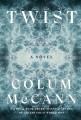 "Anthony Fennell, an Irish journalist and playwright, is assigned to cover the story of the underwater cables that carry the world's information. The sum of human existence-words, images, transactions, memes, voices, viruses-travels through the tiny fiber optic tubes. But sometimes the tubes break at an unfathomable depth. Fennell's literary adventure brings him to the west coast of Africa where he uncovers a story about the raw human labor behind the dazzling veneer of the technological world. He meets a fellow Irishman, John Conway, the chief of mission on a cable repair ship. The mysterious Conway is a skilled engineer and a freediver capable of reaching extraordinary depths. He is also in love with a South African actress, Zanele, who must leave to go on her own journey to London. When the boat is sent up the west coast of Africa to repair a series of major underwater breaks, both men learn that the very cables they seek to fix carry the news that may cause their lives to unravel. At sea, they are forced to confront the most elemental questions of life, love, absence, belonging and the perils of our severed connections. Can we, in our fractured world, reweave ourselves out of the thin, broken threads of our pasts? Can the ruptured things awaken us from our despair?"--
- Subjects: Psychological fiction.; Novels.; Cables, Submarine; Families; Interpersonal relations; Journalists; Life change events; Man-woman relationships; Truth;
- Available copies: 1 / Total copies: 1
-
unAPI
- Soundtrack to a coup d'etat [videorecording] / by Armstrong, Louis,1901-1971,on-screen participant.; Blouin, Andrée,1921-1986,on-screen participant.; Coltrane, John,1926-1967,on-screen participant.; Grimonprez, Johan,film director,screenwriter.; Kino Lorber, Inc.,publisher.;
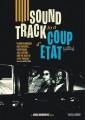 Louis Armstrong, Andrě Blouin, John Coltrane.United Nations, 1960: the Global South ignites a political earthquake, jazz musicians Abbey Lincoln and Max Roach crash the Security Council, Nikita Khrushchev bangs his shoe, and the U.S. State Department swings into action, sending jazz ambassador Louis Armstrong to Congo to deflect attention from the CIA-backed coup. Director Johan Grimonprez captures the moment when African politics and American jazz collided in this magnificent essay film, a riveting historical rollercoaster that illuminates the political machinations behind the 1961 assassination of Congo's leader Patrice Lumumba. Richly illustrated by eyewitness accounts, official government memos, testimonies from mercenaries and CIA operatives, speeches from Lumumba himself, and a veritable canon of jazz icons, Soundtrack to a Coup d'Etat interrogates colonial history to tell an urgent and timely story of precedent that resonates more than ever in today's geopolitical climate.E.DVD ; wide screen presentation ; Dolby Digital 5.1, Dolby Digital 2.0.
- Subjects: Video recordings for the hearing impaired.; Documentary films.; Historical films.; Lumumba, Patrice, 1925-1961; United Nations. Security Council; Jazz musicians; Cold War; Coups d'etat; Geopolitics;
- For private home use only.
- Available copies: 1 / Total copies: 1
-
unAPI
- Black ghost of empire : the long death of slavery and the failure of emancipation / by Manjapra, Kris,1978-author.;
 Includes bibliographical references and index."The 1619 Project illuminated the ways in which every aspect of life in the United States was and is shaped by the existence of slavery. Black Ghost of Empire focuses on emancipation and how this opportunity to make right further codified the racial caste system-instead of obliterating it. To understand why the shadow of slavery still haunts society today, we must not only look at what slavery was, but also the unfinished way it ended. One may think of "emancipation" as a finale, leading to a new age of human rights and universal freedoms. But in reality, emancipations everywhere were incomplete. In Black Ghost of Empire, acclaimed historian and professor Kris Manjapra identifies five types of emancipation--explaining them in chronological order--along with the lasting impact these transitions had on formerly enslaved groups around the Atlantic. Beginning in 1770s and concluding in 1880s, different kinds of emancipation processes took place across the Atlantic world. These included the Gradual Emancipations of North America, the Revolutionary Emancipation of Haiti, the Compensated Emancipations of European overseas empires, the War Emancipation of the American South, and the Conquest Emancipations that swept across Sub-Saharan Africa. Tragically, despite a century of abolitions and emancipations, systems of social bondage persisted and reconfigured. We still live with these unfinished endings today. In practice, all the slavery emancipations that have ever taken place reenacted racial violence against Black communities, and reaffirmed commitment to white supremacy. The devil lurked in the details of the five emancipation processes, none of which required atonement for wrongs committed, or restorative justice for the people harmed. Manjapra shows how, amidst this unfinished history, grassroots Black organizers and activists have become custodians of collective recovery and remedy; not only for our present, but also for our relationship with the past. Timely, lucid, and crucial to our understanding of the ongoing "anti-mattering" of Black people, Black Ghost of Empire shines a light into the deep gap between the idea of slavery's end and its actual perpetuation in various forms--exposing the shadows that linger to this day"--
- Subjects: Liberty; Race relations; Slavery;
- Available copies: 1 / Total copies: 1
-
unAPI
Results 201 to 210 of 272 | « previous | next »