Results 1 to 10 of 50 | next »
- The power of geography : ten maps that reveal the future of our world / by Marshall, Tim,1959-author.;
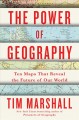 Includes bibliographical references and index."Tim Marshall's global bestseller Prisoners of Geography offered us a "fresh way of looking at maps" (The New York Times Book Review), showing how every nation's choices are limited by mountains, rivers, seas and concrete. Since then, the geography hasn't changed, but the world has. Now, in this revelatory new book, Marshall takes us into ten regions that are set to shape global politics and power. Find out why the Earth's atmosphere is the world's next battleground; why the fight for the Pacific is just beginning; and why Europe's next refugee crisis is closer than we think. In ten chapters covering Australia, The Sahel, Greece, Turkey, the UK, Iran, Ethiopia, Saudi Arabia, Spain and Space, Marshall explains how a region's geography and physical characteristics affect the decisions made by its leaders. Innovative, compelling, and delivered with Marshall's trademark wit and insight, this is a gripping and enlightening exploration of the power of geography to shape humanity's past, present, and-most importantly-our future"--
- Subjects: Geopolitics.; World politics.;
- Available copies: 1 / Total copies: 1
-
unAPI
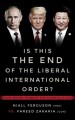
- Is this the end of the liberal international order? : Niall Ferguson vs. Fareed Zakaria : the Munk debate on geopolitics / by Ferguson, Niall.; Zakaria, Fareed.; Griffiths, Rudyard.;
 LSC
LSC- Subjects: Geopolitics; Internationalism.; Internationalism;
- Available copies: 1 / Total copies: 1
-
unAPI
- Never / by Follett, Ken,author.;
 "The new must-read epic from master storyteller Ken Follett: more than a thriller, it's an action-packed, globe-spanning drama set in the present day"--
- Subjects: Thrillers (Fiction); Chemical warfare; Deserts; Escalation (Military science); Geopolitics; Geopolitics; Geopolitics; Nuclear warfare; Spies; Terrorists;
- Available copies: 3 / Total copies: 5
-
unAPI
- The age of walls : how barriers between nations are changing our world / by Marshall, Tim,1959-author.;
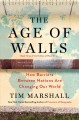 Includes bibliographical references (pages 259-264) and index."Tim Marshall ... analyzes the most urgent and tenacious topics in global politics and international relations by examining the borders, walls, and boundaries that divide countries and their populations. The globe has always been a world of walls, from the Great Wall of China to Hadrian's Wall to the Berlin Wall. But a new age of isolationism and economic nationalism is upon us, visible not just in Trump's obsession with building a wall on the Mexico border or in Britain's Brexit vote but in many other places as well. China has the great Firewall, holding back Western culture. Europe's countries are walling themselves against immigrants, terrorism, and currency issues. South Africa has heavily gated communities, and massive walls or fences separate people in the Middle East, Korea, Sudan, India, and other places around the world. In fact, at least sixty-five countries, more than a third of the world's nation-states, have barriers along their borders. There are many reasons why walls go up, because we are divided in many ways: wealth, race, religion, and politics, to name a few. Understanding what is behind these divisions is essential to understanding much of what's going on in the world today"--
- Subjects: World politics.; Geopolitics.; Walls.; Boundaries.; Border security.;
- Available copies: 1 / Total copies: 1
-
unAPI
- Prisoners of geography : ten maps that explain everything about the world / by Marshall, Tim,1959-author.;
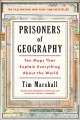 Includes bibliographical references (pages 267-272) and index.A journalist uses ten maps of crucial regions to explain the geopolitical strategies of the world powers.
- Subjects: Geopolitics.; Maps; World politics.;
- Available copies: 1 / Total copies: 1
-
unAPI
- If Russia Wins : A Scenario. by Masala, Carlo.;
 An international bestseller from a NATO expert, this deeply researched and chillingly plausible scenario imagines what might happen should Putin defeat Ukraine and not stop there. Please note page count.Library Bound Incorporated
- Subjects: POLITICAL SCIENCE / Geopolitics; POLITICAL SCIENCE / International Relations / Diplomacy; POLITICAL SCIENCE / Security (National & International);
- Available copies: 0 / Total copies: 1
-
unAPI
- How to Win a Trade War. by Keynes, Soumaya.;
 Everything we know about trade has changed. With Trumps tariffs throwing everything up in the air, this is the book to explain the eruption. In 'How to Win a Trade War', trade experts Soumaya Keynes and Chad Bown argue for a new way of operating between the biggest economic powers in the world.Library Bound Incorporated
- Subjects: BUSINESS & ECONOMICS / International / Economics & Trade; POLITICAL SCIENCE / Geopolitics; POLITICAL SCIENCE / International Relations / General;
- Available copies: 0 / Total copies: 1
-
unAPI
- Waste land : a world in permanent crisis / by Kaplan, Robert D.,1952-author.;
 "We are entering a new era of global cataclysm in which the world faces a deadly mix of war, climate change, great power rivalry, rapid technological advancement, the end of both monarchy and empire, and countless other dangers. In Waste Land, Robert D. Kaplan, geopolitical expert and author of more than twenty books on world affairs, incisively explains how we got here and where we are going. Kaplan makes a novel argument that the current geopolitical landscape must be considered alongside contemporary social phenomena such as urbanization and digital news media, grounding his ideas in foundational modern works of philosophy, politics, and literature, including the poem from which the title is borrowed, and celebrating a canon of traditionally conservative thinkers, including Alexander Solzhenitsyn, Jeane Kirkpatrick, and many others. As in many of his books, Kaplan looks to history and literature to inform the present, drawing particular comparisons between today's challenges and the Weimar Republic, the post-World War I democratic German government that fell to Nazism in the 1930s. Just as in Weimar, which faced myriad crises inextricably bound up with global systems, the singular dilemmas of the twenty-first century -- pandemic disease, recession, mass migration, the destabilizing effects of large-scale democracy and great power conflicts, and the intimate bonds created by technology -- mean that every disaster in one country has the potential to become a global crisis, too. According to Kaplan, the solutions lie in prioritizing order in governing systems, arguing that stability and historic liberalism rather than mass democracy per se will save global populations from an anarchic future"--
- Subjects: Geopolitics.; Globalization; International relations; Power (Social sciences);
- Available copies: 1 / Total copies: 1
-
unAPI
- The return of history : conflict, migration, and geopolitics in the twenty-first century / by Welsh, Jennifer M.(Jennifer Mary),1965-;
 Includes bibliographical references, Internet addresses and index.LSC
- Subjects: History; World politics; Civilization.; Regression (Civilization); Progress.;
- Available copies: 1 / Total copies: 1
-
unAPI
- Near abroad : Putin, the West, and the contest over Ukraine and the Caucasus / by Toal, Gerard,author.;
 Includes bibliographical references and index."Vladimir Putin's intervention into the Georgia/South Ossetia conflict in summer 2008 was quickly recognized by Western critics as an attempt by Russia to increase its presence and power in the "near abroad", or the independent states of the former Soviet Union that Russia still regards as its wards. Though the global economic recession that began in 2008 moved the incident to the back of the world's mind, Russia surged to the forefront again six years later when they invaded the heavily Russian Crimea in Ukraine and annexed it. In contrast to the earlier Georgia episode, this new conflict has generated a crisis of global proportions, forcing European countries to rethink their relationship with Russia and their reliance on it for energy supplies, as Russia was now squeezing natural gas from what is technically Ukraine. In Near Abroad, the eminent political geographer Gerard Toal analyzes Russia's recent offensive actions in the near abroad, focusing in particular on the ways in which both the West and Russia have relied on Cold War-era rhetorical and emotional tropes that distort as much as they clarify. In response to Russian aggression, US critics quickly turned to tried-and-true concepts like "spheres of influence" to condemn the Kremlin. Russia in turn has brought back its long tradition of criticizing western liberalism and degeneracy to grandly rationalize its behavior in what are essentially local border skirmishes. It is this tendency to resort to the frames of earlier eras that has led the conflicts to "jump scales," moving from the regional to the global level in short order. The ambiguities and contradictions that result when nations marshal traditional geopolitical arguments-rooted in geography, territory, and old understandings of distance-further contributes to the escalation of these conflicts. Indeed, Russia's belligerence toward Georgia stemmed from concern about its possible entry into NATO, an organization of states thousands of miles away. American hawks also strained credulity by portraying Georgia as a nearby ally in need of assistance. Similarly, the threat of NATO to the Ukraine looms large in the Kremlin's thinking, and many Ukrainians themselves self-identify with the West despite their location in Eastern Europe."--
- Subjects: Geopolitics; Geopolitics; Geopolitics; South Ossetia War, 2008.;
- Available copies: 1 / Total copies: 1
-
unAPI
Results 1 to 10 of 50 | next »