Results 51 to 60 of 82 | « previous | next »
- The body keeps the score : brain, mind, and body in the healing of trauma / by Van der Kolk, Bessel A.,1943-author.;
 Includes bibliographical references and index.
- Subjects: Post-traumatic stress disorder;
- Available copies: 1 / Total copies: 2
-
unAPI
- Joy of solitude : how to reconnect with yourself in an overconnected world / by Coplan, Robert J.,1967-author.;
 Includes bibliographical references and index."Solitude is part of the human experience. But just like other relationships, your relationship with solitude can be satisfying, intimate, and enhance your well-being, or it can leave you wanting, stuck in a cycle of sadness, anxiety, or anger. Regardless of whether you're starved for "me time" or struggling with loneliness, most of us have never thought carefully about how to get the most out of the time we spend by ourselves. As a result, we're missing out on what could be a deeply enriching aspect of our lives. But how can we unlock the positive power of solitude? In The Joy of Solitude, Robert Coplan draws from diverse fields including psychology, neuroscience, literature, and sociology to guide readers through solitude's many dimensions and its profound effects on mental health and well-being"--
- Subjects: Joy.; Loneliness.; Mental health.; Solitude.;
- Available copies: 0 / Total copies: 1
-
unAPI
- How confidence works : the new science of self-belief, why some people learn it and others don't / by Robertson, Ian H.,author.;
 Includes bibliographical references and index.Imagine we could discover something that could make us richer, healthier, longer-living, smarter, kinder, happier, more motivated and more innovative. Ridiculous, you might say ... What is this elixir? Confidence. If you have it, it can empower you to reach heights you never thought possible. But if you don't, it can have a devastating effect on your future. Confidence lies at the core of what makes things happen. Probing the science and neuroscience behind confidence that has emerged over the last decade, Professor Ian Robertson tells us how confidence plays out in our minds, our brains and indeed our bodies. He explains where it comes from and how it spreads -with extraordinary economic and political consequences. And why it's not necessarily something you are born with, but something that can be learned.
- Subjects: Attitude (Psychology); Confidence; Confidence; Confidence.;
- Available copies: 0 / Total copies: 1
-
unAPI
- How to know a person : the art of seeing others deeply and being deeply seen / by Brooks, David,1961-author.;
 Includes bibliographical references and index.According to David Brooks, "There is one skill that lies at the heart of any healthy person, family, school, community organization, or society: the ability to see someone else deeply and make them feel seen-to accurately know another person, to let them feel valued, heard, and understood." Drawing from the fields of psychology and neuroscience and from the worlds of theater, philosophy, history and education, one of the nation's leading writers and commentators helps us become more understanding and considerate toward others, and to find the joy that comes from being seen. 'How to Know a Person' is a practical, heartfelt guide to the art of truly knowing another person in order to foster deeper connections at home, at work, and throughout our lives.
- Subjects: Caring.; Interpersonal relations.; Social interaction.; Social psychology.;
- Available copies: 1 / Total copies: 1
-
unAPI
- Nightmare obscura : a dream engineer's guide through the sleeping mind / by Carr, Michelle,author.;
 Includes bibliographical references and index."A leading sleep expert reveals the latest science behind the dreaming brain and why we have nightmares-offering key insights into how harnessing dreams can improve your sleep and health. To most, dreams are things that slip away when you reemerge into the waking world, their remnants jumbled up and only half recalled. At their best, they are populated by pleasant recollections and surreal experiences. But at their worst, they can be traumatizing and prevent us from receiving the necessary benefits of sleep. So why do we dream at all? What makes a person prone to nightmares? How do our bodies interface with our brains when we're not awake? And how can we harness our sleeping minds to improve our waking lives? In Nightmare Obscura, dream researcher Michelle Carr unlocks the science behind the sleeping body, exploring the relationship between dreams and mental health, with a deep dive into the neuroscience behind some of the most interesting aspects of dreaming: nightmares, lucid dreams, and the cutting-edge field of dream engineering"--
- Subjects: Dreams; Nightmares.; Sleep;
- Available copies: 1 / Total copies: 1
-
unAPI
- Matrescence : on the metamorphosis of pregnancy, childbirth and motherhood / by Jones, Lucy(Journalist),author.;
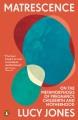 Includes bibliographical references and index."In this important and ground-breaking, deeply personal investigation, Jones writes of the emerging concept of "matrescence" -- the wholeness of becoming a mother. Drawing on her own experiences of twice becoming a mother, as well as exploring the latest research in the fields of neuroscience and evolutionary biology; psychoanalysis and existential therapy, sociology, economics and ecology, Jones writes of the physical and emotional changes in the maternal mind, body, and spirit and shows us how these changes are far more profound, wild, and enduring than have been previously explored or written about. Part memoir, part scientific and health reporting, part social critique, ecological philosophy, eco-feminism and nature writing, Matrescence is a kind of whodunnit, ferreting out with the most nuanced, searing and honest observations, why mothers throughout this heightened transition are at a breaking point, and what the institution of intensive, isolated motherhood can tell us about our still-dominant social and cultural myths"--
- Subjects: Childbirth; Motherhood; Mothers; Pregnancy.; Motherhood;
- Available copies: 1 / Total copies: 1
-
unAPI
- 31-day food revolution : heal your body, feel great, and transform your world / by Robbins, Ocean,1973-author.; Fuhrman, Joel,writer of foreword.;
 Includes bibliographical references and index.
- Subjects: Cookbooks.; Recipes.; Cooking (Natural foods); Nutrition.; Diet therapy.;
- Available copies: 1 / Total copies: 1
-
unAPI
- Hope for cynics : the surprising science of human goodness / by Zaki, Jamil,1980-author.;
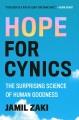 Includes bibliographical references and index."Runaway cynicism is turning our world into a meaner, sicker place; director of the Stanford Social Neuroscience Lab, Dr. Jamil Zaki, is about to disrupt this narrative. For thousands of years, people have argued about whether humanity is selfish or generous, cruel or kind. In 1972, half of Americans agreed that most people can be trusted; by 2018, that figure had fallen to 30%. Different generations, genders, religions, and political parties can't seem to agree on anything, except, perhaps, on one idea: that human virtue is evaporating. Cynicism is a perfectly understandable response to a world full of injustice, harm, and inequality. But in many cases, cynicism has become the first -- or only -- tool that people reach for these days. It is the psychological hammer of our age, and we are treating others more and more like nails. Knee-jerk cynicism worsens social problems because our beliefs don't just reflect the world -- they change it. When we expect people to be awful, we coax awfulness out of them. Cynicism is a disease, with a history, symptoms, and a cure"--
- Subjects: Cynicism; Hope.; Social justice;
- Available copies: 0 / Total copies: 1
-
unAPI
- You're not listening : what you're missing and why it matters / by Murphy, Kate(Journalist),author.;
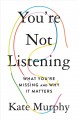 Includes bibliographical references and index."At work, we're taught to lead the conversation. On social media, we shape our personal narratives. At parties, we talk over one another. So do our politicians. We're not listening. And no one is listening to us. Despite living in a world where technology allows constant digital communication and opportunities to connect, it seems no one is really listening or even knows how. And it's making us lonelier, more isolated, and less tolerant than ever before. A listener by trade, New York Times contributor Kate Murphy wanted to know how we got here. In this always illuminating and often humorous deep dive, Murphy explains why we're not listening, what it's doing to us, and how we can reverse the trend. She makes accessible the psychology, neuroscience, and sociology of listening while also introducing us to some of the best listeners out there (including a CIA agent, focus group moderator, bartender, radio producer, and top furniture salesman). Equal parts cutting expose, rousing call to action, and practical advice, You're Not Listening is to listening what Susan Cain's Quiet was to introversion. It's time to stop talking and start listening"--
- Subjects: Interpersonal communication.; Listening.;
- Available copies: 1 / Total copies: 1
-
unAPI
- The hunger habit : why we eat when we're not hungry and how to stop / by Brewer, Judson,author.;
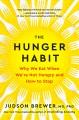 Includes bibliographical references and index."A program proven to heal our relationship with food and our bodies from New York Times bestselling author of Unwinding Anxiety. Anyone who struggles with overeating knows what it's like to feel out of control-and to feel the guilt attached to it. While ordinary anxiety feels like something that happens to us, the siren song of food cravings feels like something we should be able to control. The result is a toxic cocktail of shame and self-loathing that makes it impossible to change our behavior. The Hunger Habit is based on Judson Brewer's deeply researched plan proven to help us understand what is going on in our brains so that we can heal the shame and overcome overeating. The step-by-step program focuses on the power of awareness-there is no willpower, calorie-counting, or restricted eating. Setbacks are a good thing! The key is to learn how to work with our brains rather than to fight cravings, and to adopt an attitude of self-kindness rather than self-judgment. Grounded in cutting-edge neuroscience, The Hunger Habit is both accessible and compassionate. It will finally help you break out of food jail and reclaim your life"--
- Subjects: Self-help publications.; Change (Psychology); Compulsive eating.; Food habits; Habit breaking.; Hyperphagia.; Mindfulness (Psychology);
- Available copies: 1 / Total copies: 1
-
unAPI
Results 51 to 60 of 82 | « previous | next »